
Schizophrenia & Psychotic Disorders: PMHNP Board Review
PMHNP board review of schizophrenia and psychotic disorders: positive/negative symptoms, duration distinctions, antipsychotics, and clozapine.
Schizophrenia is a chronic psychotic disorder defined by at least two of five core symptoms (delusions, hallucinations, disorganized speech, grossly disorganized or catatonic behavior, and negative symptoms) for a significant portion of one month, with continuous signs of disturbance for at least 6 months. The single highest-yield board point: the 6-month total duration (including prodromal/residual phases) is what separates schizophrenia from schizophreniform disorder — and at least one of the two required symptoms must be delusions, hallucinations, or disorganized speech.
This review covers the symptom domains, the duration-based differential among psychotic disorders, and antipsychotic management including clozapine.
Epidemiology and course
Schizophrenia affects roughly 0.5–1% of the population worldwide with a fairly even sex distribution, though men tend to present earlier (late teens to early 20s) than women (late 20s, with a second smaller peak after 40). A prodromal phase of social withdrawal, declining function, and odd beliefs often precedes the first psychotic break. The course is typically chronic with relapses; early intervention and adherence are the strongest modifiable predictors of outcome, and each relapse may worsen the long-term trajectory. Risk factors include family history (heritability is high), obstetric complications, winter birth, cannabis use in adolescence, and advanced paternal age. Life expectancy is reduced — largely from cardiovascular disease and elevated suicide risk — which is why metabolic monitoring during antipsychotic treatment is so heavily emphasized.
Diagnostic criteria (DSM-5-TR)
Criterion A requires two or more of the following, each present for a significant portion of time during a 1-month period (or less if successfully treated). At least one must be from the first three:
- Delusions
- Hallucinations
- Disorganized speech (e.g., frequent derailment or incoherence)
- Grossly disorganized or catatonic behavior
- Negative symptoms (diminished emotional expression or avolition)
Additional criteria:
- Functional decline in work, relationships, or self-care.
- Duration: continuous signs of disturbance for at least 6 months, including at least 1 month of active-phase (Criterion A) symptoms; the rest may be prodromal or residual.
- Exclusions: schizoaffective and mood disorders with psychotic features are ruled out; not due to a substance or medical condition.
Clinical features and differential
Positive vs. negative symptoms
- Positive symptoms (added experiences): delusions, hallucinations (auditory most common), disorganized speech and behavior. These respond best to antipsychotics.
- Negative symptoms (deficits): the 5 A's — affective flattening, alogia (poverty of speech), anhedonia, avolition, asociality. These are harder to treat and drive long-term disability.
- Cognitive symptoms: impaired attention, working memory, and executive function.
Duration-based differential — the classic exam grid
- Brief psychotic disorder: symptoms more than 1 day but less than 1 month, with full return to baseline.
- Schizophreniform disorder: symptoms 1 to 6 months (same Criterion A as schizophrenia, shorter total duration).
- Schizophrenia: 6 months or more of continuous disturbance.
- Schizoaffective disorder: an uninterrupted period with a major mood episode concurrent with Criterion A symptoms, plus delusions or hallucinations for at least 2 weeks in the absence of a mood episode (this 2-week criterion is what separates it from a mood disorder with psychotic features — see the bipolar review and MDD review).
- Delusional disorder: at least 1 month of delusions without other Criterion A symptoms; functioning otherwise relatively preserved.
Always rule out substance-induced psychosis (stimulants, cannabis, hallucinogens, phencyclidine) and medical causes (delirium, temporal lobe epilepsy, autoimmune/NMDA-receptor encephalitis, neurosyphilis, thyroid disease, B12 deficiency, and CNS lesions). A new psychotic presentation typically warrants a basic medical and toxicology workup before anchoring on a primary psychotic disorder, especially when onset is abrupt, the patient is older than the usual range, or there are focal neurologic signs, fluctuating consciousness, or prominent visual hallucinations (which point more toward a medical or substance etiology than schizophrenia, where hallucinations are usually auditory).
First-line treatment
Antipsychotics
Second-generation (atypical) antipsychotics are generally first-line because of a lower risk of extrapyramidal symptoms (EPS) and tardive dyskinesia, despite a higher metabolic burden.
- Atypicals: risperidone, olanzapine, quetiapine, aripiprazole, ziprasidone, lurasidone, paliperidone, cariprazine.
- Typicals (first-generation): haloperidol, fluphenazine, chlorpromazine — potent for positive symptoms but higher EPS risk.
Mechanism: all act at dopamine D2 receptors — antagonism for most agents, partial agonism for aripiprazole and cariprazine; atypicals add serotonin 5-HT2A antagonism. The dopamine hypothesis frames psychosis as mesolimbic dopamine excess (positive symptoms) with mesocortical dopamine deficit (negative/cognitive symptoms). Antipsychotics primarily improve positive symptoms; negative and cognitive symptoms respond less.
Side effects you must know
- Extrapyramidal symptoms (EPS): acute dystonia (treat with anticholinergics like benztropine or diphenhydramine), akathisia (motor restlessness — reduce dose, consider propranolol; do not mistake for agitation and uptitrate), and drug-induced parkinsonism.
- Tardive dyskinesia: late-onset, potentially irreversible involuntary movements; higher risk with first-generation agents and long exposure. VMAT2 inhibitors (valbenazine, deutetrabenazine) treat it.
- Neuroleptic malignant syndrome (NMS): fever, "lead-pipe" rigidity, autonomic instability, altered mental status, elevated CK — a life-threatening emergency; stop the antipsychotic and provide supportive care (dantrolene/bromocriptine).
- Metabolic syndrome: weight gain, dyslipidemia, and diabetes, worst with olanzapine and clozapine; monitor weight/BMI, fasting glucose, and lipids.
- Hyperprolactinemia: galactorrhea, amenorrhea, sexual dysfunction — prominent with risperidone/paliperidone; aripiprazole is prolactin-sparing.
- QT prolongation: notable with ziprasidone and some others — check baseline ECG when indicated.
For the full side-effect framework, see antipsychotic side effects for the PMHNP and PMHNP psychopharmacology high-yield.
Adherence and formulation
Long-acting injectable (LAI) antipsychotics improve adherence and reduce relapse in patients with poor adherence — a high-yield management answer.
Clozapine for treatment resistance
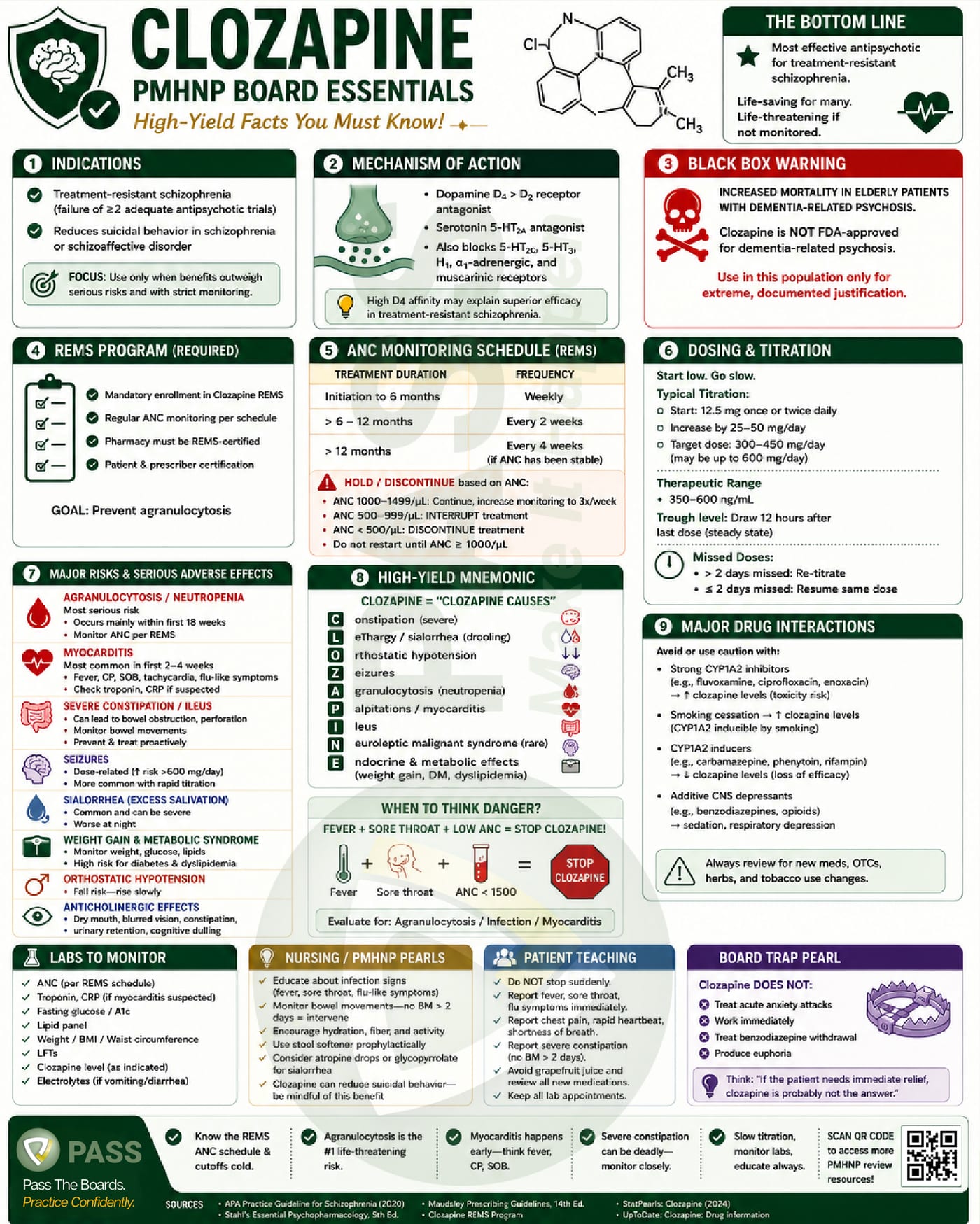
Clozapine is the most effective antipsychotic and the gold standard for treatment-resistant schizophrenia (failure of two adequate antipsychotic trials) and for reducing suicidality in schizophrenia.
Its use is limited by serious adverse effects requiring strict monitoring:
- Agranulocytosis: mandatory absolute neutrophil count (ANC) monitoring via a REMS program (weekly initially).
- Myocarditis, seizures (dose-related), metabolic effects, severe constipation/ileus, and sialorrhea.
Clozapine is reserved for treatment resistance precisely because of this monitoring burden — never a first-line agent.
Psychosocial treatment
Medication plus psychosocial interventions — assertive community treatment, supported employment, social skills training, family psychoeducation, and CBT for psychosis — produces the best outcomes. Family interventions that reduce high expressed emotion (criticism, hostility, over-involvement) lower relapse rates and are a tested concept. Coordinated specialty care for first-episode psychosis improves long-term function and is the recommended model after an initial break.
Acute agitation
For acute agitation or aggression, first attempt verbal de-escalation and a low-stimulation environment. When medication is needed, options include an oral or intramuscular antipsychotic (e.g., haloperidol or olanzapine), sometimes combined with a benzodiazepine; avoid coadministering intramuscular olanzapine and a benzodiazepine closely together because of respiratory and cardiovascular depression risk.
High-yield board pearls
- Schizophrenia needs 6 months total duration with at least 1 month of active symptoms; schizophreniform is 1–6 months; brief psychotic disorder is under 1 month.
- At least one Criterion A symptom must be delusions, hallucinations, or disorganized speech.
- Negative symptoms (the 5 A's) drive long-term disability and respond poorly to medication.
- Schizoaffective disorder requires psychosis for at least 2 weeks without a mood episode.
- Clozapine is reserved for treatment-resistant schizophrenia and reduces suicide risk, but mandates ANC monitoring.
- LAIs are the go-to for adherence problems.
Common exam traps
- Confusing schizophreniform with schizophrenia. The only difference is total duration (1–6 months vs. 6+ months).
- Calling mood-congruent psychosis schizoaffective disorder. Without psychosis persisting 2+ weeks outside the mood episode, it is a mood disorder with psychotic features.
- Using clozapine first-line. It is third-line, reserved for treatment resistance.
- Forgetting clozapine's ANC monitoring and its risks of myocarditis, seizures, and ileus.
- Treating negative symptoms aggressively with antipsychotics and expecting full resolution.
- Missing substance-induced psychosis in a young patient using stimulants or cannabis.
All clinical decisions should follow current guidelines and individualized assessment; this is educational content.
Practice psychotic-disorder questions on PASSNP
The duration grid and the clozapine criteria are perennial PMHNP exam favorites. PASSNP delivers verified, rationale-rich questions on schizophrenia and the full psychotic-disorder spectrum. Take a free diagnostic assessment, explore the PMHNP question bank, or register for free to start drilling these distinctions today.
Frequently asked questions
How long must symptoms last to diagnose schizophrenia?
Schizophrenia requires continuous signs of disturbance for at least 6 months, including at least 1 month of active-phase Criterion A symptoms (the remainder may be prodromal or residual). If the total duration is 1 to 6 months, the diagnosis is schizophreniform disorder; under 1 month with return to baseline, it is brief psychotic disorder.
What are positive versus negative symptoms of schizophrenia?
Positive symptoms are added experiences such as delusions, hallucinations, and disorganized speech or behavior, and respond best to antipsychotics. Negative symptoms are deficits captured by the 5 A's: affective flattening, alogia, anhedonia, avolition, and asociality. Negative symptoms respond poorly to medication and drive long-term disability.
When is clozapine indicated, and what monitoring does it require?
Clozapine is reserved for treatment-resistant schizophrenia, defined as failure of two adequate antipsychotic trials, and it also reduces suicidality. Because it can cause agranulocytosis, it requires absolute neutrophil count monitoring through a REMS program (weekly at first). Other serious risks include myocarditis, seizures, severe constipation or ileus, and metabolic effects.
How is schizoaffective disorder distinguished from a mood disorder with psychotic features?
Schizoaffective disorder requires delusions or hallucinations for at least 2 weeks in the absence of a major mood episode, alongside periods when a mood episode co-occurs with psychosis. If psychosis occurs only during mood episodes, the diagnosis is a mood disorder with psychotic features rather than schizoaffective disorder.
Which antipsychotics are first-line for schizophrenia?
Second-generation (atypical) antipsychotics such as risperidone, aripiprazole, and others are generally first-line because they carry a lower risk of extrapyramidal symptoms and tardive dyskinesia, though they have a higher metabolic burden. Long-acting injectable formulations are preferred when adherence is a concern.
Related articles
Both PMHNP board blueprints broken down by domain and question count, plus the daily study system and high-yield content matrix that turn those weights into a study plan.
Since 2024, psychiatric NPs can certify through two boards: the long-standing ANCC PMHNP-BC or the newer AANPCB PMHNP-C. Here's how the two exams compare and how to choose.
PMHNP board review of perinatal mood disorders: baby blues vs postpartum depression vs psychosis, EPDS screening, SSRIs in pregnancy, and brexanolone.
Ready to practice what you just read?
Practice questions with full rationales. Sample your specialty free.
No credit card required · No subscription, no auto-renew