
Bipolar I vs. Bipolar II: PMHNP Board Review
PMHNP board review of bipolar I vs. bipolar II: mania vs. hypomania, mood stabilizers, antidepressant cautions, and lithium pearls.
Bipolar I disorder requires at least one lifetime manic episode, while bipolar II disorder requires at least one hypomanic episode plus at least one major depressive episode and no history of mania. The single highest-yield board point: the manic-vs-hypomanic distinction drives the diagnosis. Mania lasts at least 7 days (or any duration requiring hospitalization), causes marked impairment or psychosis; hypomania lasts at least 4 days, is observable but does not cause marked impairment, hospitalization, or psychosis.
This review clarifies the criteria, mixed features, and pharmacologic management that the exam tests repeatedly.
Epidemiology and course
Bipolar I affects roughly 1% of the population with a near-equal sex distribution; bipolar II is somewhat more common in women. Onset typically occurs in the late teens to mid-20s, and a depressive episode is frequently the first presentation — which is why so many patients are initially misdiagnosed with unipolar depression for years. The illness is lifelong and recurrent, with patients spending substantially more time in depressive than manic states. Strong heritability (high familial and twin concordance) makes family history one of the most useful clues on a vignette. Comorbid anxiety disorders, substance use, and ADHD are common and worsen prognosis. Average delay from first symptoms to correct diagnosis is often cited as several years, underscoring the board emphasis on screening every depressed patient for past (hypo)mania.
Diagnostic criteria (DSM-5-TR)
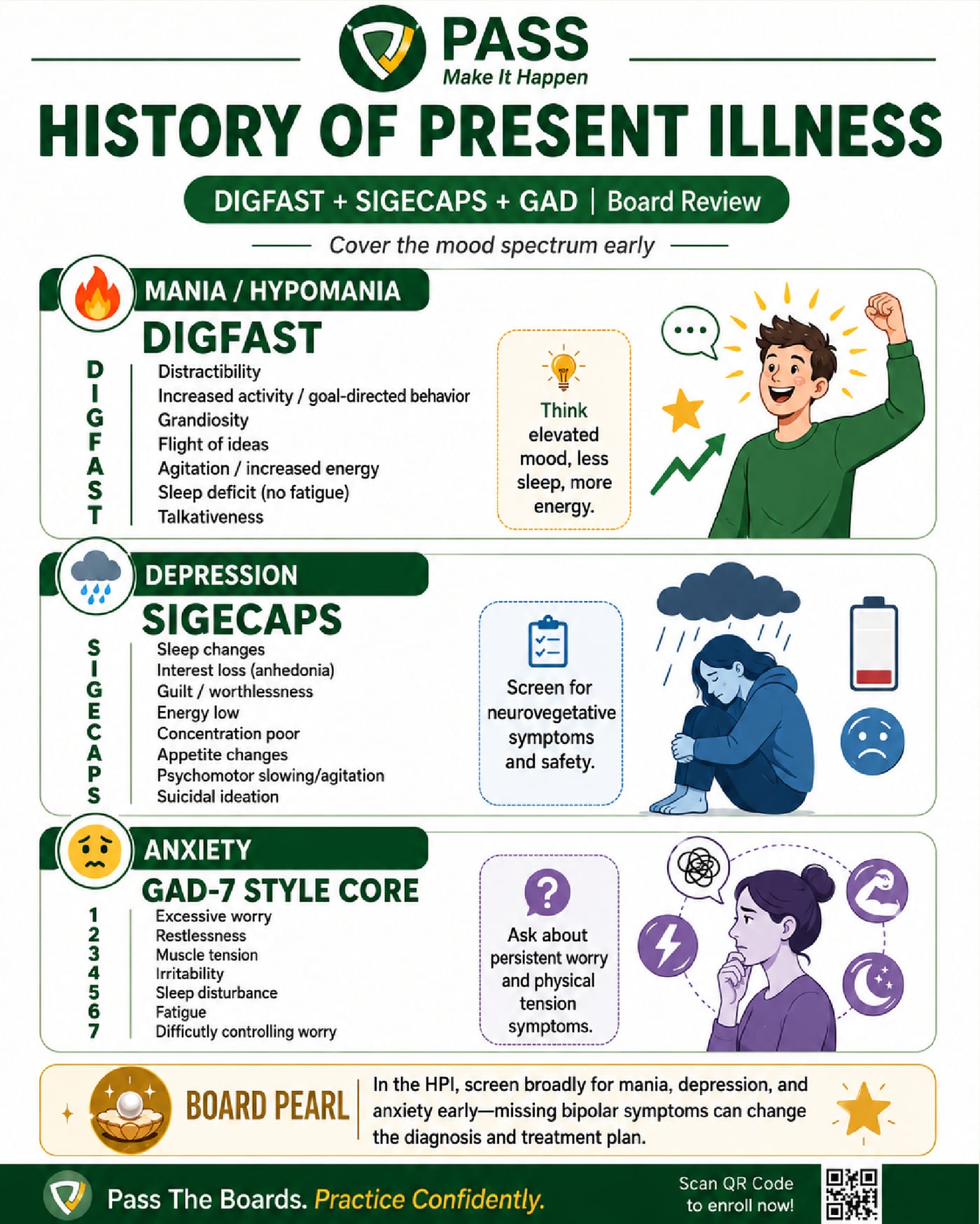
Manic episode
A distinct period of abnormally and persistently elevated, expansive, or irritable mood and increased goal-directed activity or energy, lasting at least 1 week (or any duration if hospitalization is needed), present most of the day nearly every day.
During this period, three or more of the following (four if mood is only irritable) — mnemonic DIG FAST:
- D — Distractibility
- I — Indiscretion / impulsivity (risky pleasurable activities: spending, sex, investments)
- G — Grandiosity or inflated self-esteem
- F — Flight of ideas or racing thoughts
- A — Activity increase (goal-directed) or psychomotor agitation
- S — Sleep decreased (decreased need for sleep, not insomnia)
- T — Talkativeness or pressured speech
Mania causes marked impairment, may require hospitalization, or includes psychotic features. Any one of these confirms bipolar I.
Hypomanic episode
Same symptom criteria, but lasting at least 4 consecutive days. The change is observable by others but is not severe enough to cause marked functional impairment, require hospitalization, or include psychosis. If psychosis or hospitalization is present, it is mania by definition — not hypomania.
Putting it together
- Bipolar I: at least one manic episode (depressive episodes common but not required).
- Bipolar II: at least one hypomanic episode and at least one major depressive episode, with no lifetime manic episode.
- Cyclothymic disorder: at least 2 years of fluctuating hypomanic and depressive symptoms that never meet full episode criteria.
Mixed features specifier
DSM-5-TR uses a "with mixed features" specifier rather than a separate mixed episode. It applies when full criteria for one pole are met and at least three symptoms of the opposite pole are present concurrently. Mixed states carry elevated suicide risk and complicate treatment.
Clinical features and differential
Bipolar patients spend more time depressed than manic, so bipolar depression is the most common presentation — and the most commonly misdiagnosed as unipolar MDD. Clues favoring bipolarity in a depressed patient:
- Early age of onset, recurrent episodes
- Family history of bipolar disorder
- Postpartum onset, psychotic features, atypical features (hypersomnia, hyperphagia)
- History of antidepressant-induced activation or rapid cycling
Differentiate from MDD (no [hypo]mania — see the MDD review), schizoaffective disorder (psychosis persists outside mood episodes — see the schizophrenia review), ADHD, borderline personality disorder (mood shifts are rapid, reactive, and interpersonal — see the BPD review), and substance-induced mood disorders.
First-line treatment
Acute mania
First-line options include lithium, valproate (divalproex), and second-generation antipsychotics (quetiapine, olanzapine, risperidone, aripiprazole, cariprazine). Severe mania often needs a combination of a mood stabilizer plus an antipsychotic. Stop any antidepressant.
Bipolar depression
Key teaching point: do not use antidepressant monotherapy. Evidence-based options include quetiapine, lurasidone, cariprazine, lumateperone, and the olanzapine-fluoxetine combination. Lamotrigine is effective for maintenance and prevention of depressive relapse but is not a first-line acute antidepressant and must be titrated slowly due to Stevens-Johnson syndrome risk.
Rapid cycling
Rapid cycling is four or more mood episodes (depressive, manic, hypomanic, or mixed) within 12 months. It is more common in women and in bipolar II, predicts a poorer treatment response, and is often aggravated by antidepressants and hypothyroidism. Management favors mood stabilizers (lithium, valproate, lamotrigine) and discontinuation of antidepressants; check thyroid function.
Maintenance
Lithium is the gold-standard maintenance agent and uniquely reduces suicide risk. Lamotrigine prevents depressive episodes; several atypical antipsychotics are approved for maintenance. Maintenance is generally long-term or lifelong after a manic episode given the high relapse rate; abrupt lithium discontinuation in particular carries a high risk of rebound mania, so taper if stopping is necessary. Psychoeducation about adherence, sleep regularity, and early warning signs of relapse is a core, evidence-based adjunct.
Antidepressant cautions
- Antidepressants can trigger a manic/hypomanic switch or rapid cycling.
- If used at all, only with a mood stabilizer, and generally avoided in bipolar I and mixed states.
Lithium pearls
Lithium has a narrow therapeutic index. Memorize these:
- Therapeutic level: roughly 0.6–1.2 mEq/L (acute mania toward the higher end; maintenance lower).
- Toxicity: early — tremor, nausea, diarrhea; severe — ataxia, confusion, seizures, coma.
- Renal excretion: dehydration, NSAIDs, ACE inhibitors/ARBs, and thiazide diuretics raise lithium levels.
- Monitoring: baseline and periodic renal function (creatinine), TSH (hypothyroidism), calcium, and lithium levels; check level ~5 days after a dose change, drawn ~12 hours post-dose.
- Teratogenicity: Ebstein anomaly risk in pregnancy.
For the full monitoring framework, see lithium monitoring for the PMHNP exam.
Other mood stabilizers at a glance
- Valproate (divalproex): monitor LFTs, CBC (thrombocytopenia), and levels (~50–125 mcg/mL); teratogenic with neural tube defects and the highest risk to neurodevelopment — generally avoided in people who can become pregnant. Watch for hyperammonemia, weight gain, and tremor.
- Carbamazepine: an enzyme inducer (many drug interactions, including lowering its own and other drug levels); risks include hyponatremia, agranulocytosis, and HLA-B*1502-associated Stevens-Johnson syndrome (screen at-risk Asian ancestry).
- Lamotrigine: best for the depressive pole; the slow titration that prevents serious rash also means it is not useful for acute mania.
The board pattern: match the agent to the pole and the patient — lithium or valproate or an antipsychotic for acute mania, lamotrigine or quetiapine or lurasidone for depression, lithium for suicide-risk reduction and maintenance.
High-yield board pearls
- One manic episode = bipolar I, full stop, even without any depressive episode.
- Bipolar II requires both a hypomanic episode and a major depressive episode — never a manic one.
- Decreased need for sleep (feeling rested on little sleep) is the hallmark sleep change in mania, distinct from insomnia.
- Lithium uniquely lowers suicide risk and is the maintenance gold standard.
- Lamotrigine prevents depressive relapse but needs slow titration to avoid serious rash.
- Antidepressant monotherapy is contraindicated in bipolar depression.
Common exam traps
- Calling hypomania "mild mania." The discriminator is impairment/psychosis/hospitalization, not symptom intensity alone — any psychosis or hospitalization upgrades it to mania (bipolar I).
- Diagnosing MDD in a patient with past hypomania. That is bipolar II, and treatment differs fundamentally.
- Starting an SSRI alone for bipolar depression. Expect a switch question — pair with a mood stabilizer or choose an approved agent like quetiapine or lurasidone.
- Forgetting drug interactions that raise lithium. NSAIDs, thiazides, and ACE inhibitors/ARBs are the classic culprits.
- Rapid lamotrigine titration. Increases Stevens-Johnson/toxic epidermal necrolysis risk.
- Missing mixed features and their suicide risk.
Always apply current clinical guidelines and individualized assessment; this material is educational.
Practice bipolar questions on PASSNP
The mania-vs-hypomania line and the antidepressant-switch trap are bread-and-butter PMHNP items. PASSNP's verified question bank drills these distinctions with full rationales. Take a free diagnostic assessment, browse the PMHNP question bank, or register for free to start practicing mood-disorder and lithium questions now.
Frequently asked questions
What separates bipolar I from bipolar II?
Bipolar I requires at least one lifetime manic episode and is diagnosed even without any depressive episode. Bipolar II requires at least one hypomanic episode plus at least one major depressive episode, with no history of a full manic episode. The presence of mania versus hypomania is the central distinction.
How do mania and hypomania differ?
Mania lasts at least 7 days (or any duration if hospitalization is required), causes marked functional impairment, and may include psychosis. Hypomania lasts at least 4 days, is observable by others, but does not cause marked impairment, require hospitalization, or include psychotic features. Any psychosis or hospitalization makes the episode mania.
Why is antidepressant monotherapy avoided in bipolar disorder?
Antidepressants used alone can precipitate a manic or hypomanic switch and induce rapid cycling. Bipolar depression is instead treated with agents like quetiapine, lurasidone, cariprazine, or lamotrigine for maintenance. If an antidepressant is used at all, it should be combined with a mood stabilizer.
What are the key lithium monitoring points?
Lithium has a narrow therapeutic index (roughly 0.6 to 1.2 mEq/L). Monitor renal function, TSH, and calcium at baseline and periodically, and check levels about 5 days after a dose change drawn 12 hours post-dose. Dehydration, NSAIDs, thiazides, and ACE inhibitors or ARBs raise lithium levels and can cause toxicity.
Which medication best reduces suicide risk in bipolar disorder?
Lithium uniquely reduces suicide risk and is the gold-standard maintenance treatment for bipolar disorder. This is a frequently tested point that distinguishes lithium from other mood stabilizers and antipsychotics used in maintenance therapy.
Related articles
Both PMHNP board blueprints broken down by domain and question count, plus the daily study system and high-yield content matrix that turn those weights into a study plan.
Since 2024, psychiatric NPs can certify through two boards: the long-standing ANCC PMHNP-BC or the newer AANPCB PMHNP-C. Here's how the two exams compare and how to choose.
PMHNP board review of perinatal mood disorders: baby blues vs postpartum depression vs psychosis, EPDS screening, SSRIs in pregnancy, and brexanolone.
Ready to practice what you just read?
Practice questions with full rationales. Sample your specialty free.
No credit card required · No subscription, no auto-renew