
Major Depressive Disorder: PMHNP Board Review
High-yield PMHNP board review of major depressive disorder: DSM-5-TR criteria, PHQ-9 screening, SSRI first-line treatment, and suicide risk.
Major depressive disorder (MDD) is a mood disorder defined by at least one major depressive episode: five or more depressive symptoms present nearly every day for at least two weeks, including either depressed mood or anhedonia. The single highest-yield board point: at least one of those two cardinal symptoms (low mood or loss of interest/pleasure) must be present, and the symptoms must cause clinically significant distress or impairment without being better explained by another condition.
This review walks through the DSM-5-TR diagnosis, evidence-based first-line treatment, and the exam traps that catch test-takers.
Epidemiology and course
MDD is among the most common psychiatric disorders, with a lifetime prevalence around 20% and roughly a 2:1 female-to-male ratio that emerges in adolescence. Onset can occur at any age but peaks in the 20s. The course is typically episodic and recurrent: after a first episode, the risk of a second is roughly 50%, and risk climbs with each subsequent episode. Untreated episodes often last 6–12 months. Earlier onset, residual symptoms between episodes, comorbid anxiety or substance use, and chronic medical illness all predict a more recurrent, harder-to-treat course. Recognizing this recurrent nature underpins the board emphasis on adequate continuation and maintenance treatment rather than stopping medication the moment a patient improves.
Diagnostic criteria (DSM-5-TR)
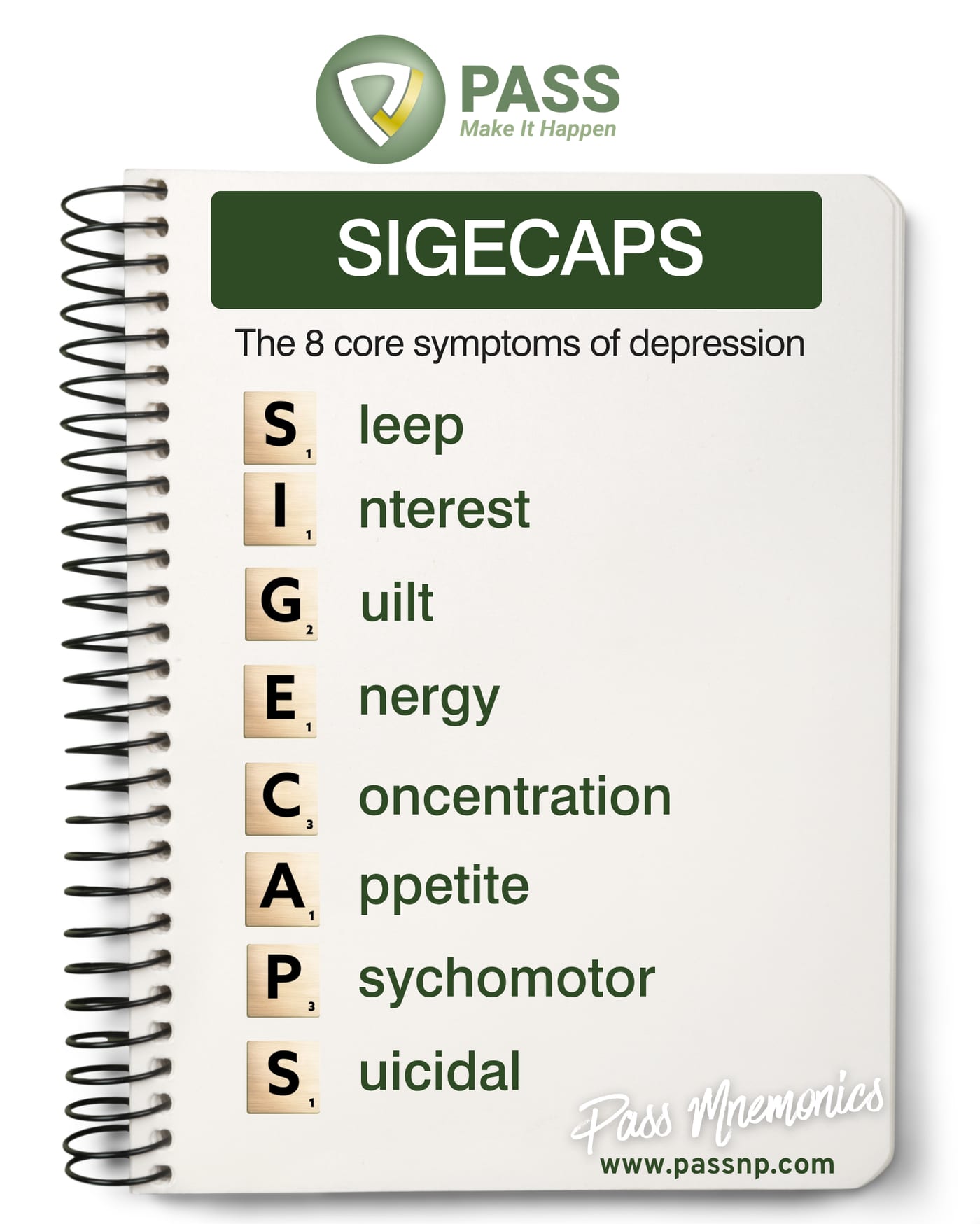
A major depressive episode requires five or more of the following symptoms during the same 2-week period, representing a change from prior functioning. At least one symptom must be depressed mood or loss of interest/pleasure.
The classic mnemonic is SIG E CAPS (plus mood/anhedonia):
- S — Sleep: insomnia or hypersomnia
- I — Interest: markedly diminished interest or pleasure (anhedonia)
- G — Guilt: feelings of worthlessness or excessive/inappropriate guilt
- E — Energy: fatigue or loss of energy
- C — Concentration: diminished ability to think, concentrate, or decide
- A — Appetite: weight or appetite change (up or down)
- P — Psychomotor: agitation or retardation (observable by others)
- S — Suicidality: recurrent thoughts of death, suicidal ideation, or a plan/attempt
Key thresholds and qualifiers:
- Duration: symptoms most of the day, nearly every day, for at least 2 weeks.
- Functional impact: clinically significant distress or impairment in social, occupational, or other functioning.
- Exclusions: not attributable to a substance or medical condition, and never a manic or hypomanic episode (which would point toward bipolar disorder — see the Bipolar I vs. Bipolar II review).
DSM-5 (2013) removed the old bereavement exclusion, and DSM-5-TR carries that forward. Grief and MDD can co-occur; clinical judgment distinguishes normal grief (waves of sadness tied to the loss, preserved self-esteem) from a superimposed depressive episode (pervasive low mood, worthlessness, persistent suicidal ideation).
Specifiers worth knowing: with anxious distress, with mixed features, with melancholic features, with atypical features, with psychotic features, with peripartum onset, and with seasonal pattern.
Clinical features and differential
MDD presents along a spectrum from low-grade dysphoria to severe episodes with psychotic features. On the boards, sharpen these distinctions:
- Persistent depressive disorder (dysthymia): depressed mood more days than not for at least 2 years (1 year in children/adolescents), with fewer acute symptoms but greater chronicity.
- Bipolar depression: a depressive episode in a patient with any lifetime manic or hypomanic episode. Always screen for past (hypo)mania before starting an antidepressant.
- Adjustment disorder with depressed mood: symptoms arise within 3 months of an identifiable stressor and do not meet full MDD criteria.
- Medical/substance causes: hypothyroidism, anemia, vitamin deficiencies, steroids, interferon, and alcohol use can mimic depression — rule these out.
- Premenstrual dysphoric disorder (PMDD): mood symptoms confined to the luteal phase.
Screening
The PHQ-9 is the most board-relevant screening and severity tool. It maps directly onto the nine DSM symptom domains, scores 0–27, and tracks treatment response. A score of 10 or higher suggests at least moderate depression. Item 9 screens for thoughts of self-harm and should always trigger a direct suicide risk assessment. The PHQ-2 is a brief two-item pre-screen.
Know the PHQ-9 severity bands for the exam: 5–9 mild, 10–14 moderate, 15–19 moderately severe, and 20–27 severe. Other tools you may encounter include the Beck Depression Inventory (BDI), the clinician-rated Hamilton Depression Rating Scale (HAM-D), and, in older adults, the Geriatric Depression Scale (GDS), which de-emphasizes somatic items that overlap with aging. For peripartum patients, the Edinburgh Postnatal Depression Scale (EPDS) is the standard. Routine measurement-based care — re-administering the PHQ-9 at follow-up visits — lets you track whether a patient is responding (typically a ≥50% reduction in score) or remitting (a score under 5).
Suicide risk assessment
Suicide is the most consequential complication of MDD, and risk stratification is heavily tested. Assess ideation, plan, intent, access to means, and prior attempts directly — asking about suicide does not increase risk. Static risk factors include prior attempts (the single strongest predictor), male sex, older age, and family history; dynamic factors include hopelessness, agitation, insomnia, recent loss, and acute substance use. The Columbia-Suicide Severity Rating Scale (C-SSRS) is a widely used structured tool. Restrict access to lethal means, mobilize support, and document a safety plan. Remember that energy can return before mood lifts early in antidepressant treatment, transiently raising the capacity to act on suicidal thoughts — a key reason for close early monitoring.
First-line treatment
Pharmacotherapy
SSRIs are first-line for most adults with MDD because of efficacy, tolerability, and safety in overdose. Common agents include sertraline, escitalopram, fluoxetine, citalopram, and paroxetine. For a deeper dive, see the SSRI PMHNP exam review.
Core prescribing principles:
- Onset: counsel patients that mood improvement typically takes 4–6 weeks; physical symptoms (sleep, appetite) may improve sooner.
- Adequate trial: maximize the dose and continue 6–8 weeks before declaring non-response.
- Duration: after remission, continue for at least 4–9 months (continuation phase); recurrent episodes warrant longer maintenance.
- Black box warning: increased suicidal ideation in patients under 25 during early treatment — monitor closely.
Other first-line and second-line options:
- SNRIs (venlafaxine, duloxetine) — useful with comorbid pain; venlafaxine can raise blood pressure at higher doses.
- Bupropion — activating, weight-neutral, low sexual side effects; avoid in seizure and active eating disorders.
- Mirtazapine — sedating and appetite-stimulating; helpful for insomnia and weight loss.
- TCAs (e.g., nortriptyline) and MAOIs (e.g., phenelzine) — effective but rarely first-line because of overdose lethality, anticholinergic and cardiac effects (TCAs), and dietary tyramine and drug-interaction restrictions (MAOIs).
For a broader framework, review PMHNP psychopharmacology high-yield.
Adverse effects to counsel and monitor
- Sexual dysfunction — the most common reason for non-adherence; consider bupropion or dose adjustment.
- Serotonin syndrome — autonomic instability, neuromuscular hyperactivity (clonus, hyperreflexia), and altered mental status, usually from combining serotonergic agents (e.g., an SSRI plus an MAOI, triptan, tramadol, or linezolid). It is a tested medical emergency.
- Discontinuation syndrome — abrupt stoppage of short-half-life agents (paroxetine, venlafaxine) causes flu-like symptoms, dizziness, and "brain zaps"; taper to avoid it. Fluoxetine's long half-life makes it the least likely to cause this.
- Hyponatremia (SIADH) — more common in older adults; check sodium when indicated.
- Bleeding risk — SSRIs impair platelet function; caution with NSAIDs or anticoagulants.
Augmentation and treatment-resistant depression
When an adequate first trial fails, options are to optimize the dose, switch agents, or augment.
- Augmentation: add an atypical antipsychotic (aripiprazole, quetiapine), lithium, or thyroid hormone (T3). Watch antipsychotic metabolic and movement effects — see antipsychotic side effects.
- Treatment-resistant depression (TRD): typically defined as failure of two adequate antidepressant trials. Options include esketamine (intranasal, REMS program), ECT (most effective for severe, psychotic, or catatonic depression and acute suicidality), and TMS.
- Psychotic depression: requires an antidepressant plus an antipsychotic, or ECT — an antidepressant alone is inadequate.
Psychotherapy
Cognitive behavioral therapy (CBT) and interpersonal therapy (IPT) are first-line, evidence-based psychotherapies. Combined medication plus psychotherapy outperforms either alone for moderate-to-severe MDD.
High-yield board pearls
- At least one cardinal symptom — depressed mood or anhedonia — is mandatory for the diagnosis.
- Always screen for prior mania/hypomania before prescribing an antidepressant to avoid inducing a manic switch.
- SSRIs are first-line; allow 4–6 weeks for full effect and an adequate 6–8 week trial before switching.
- ECT is the most effective acute treatment for severe, psychotic, or treatment-resistant depression and for acute high suicide risk.
- Continue treatment 4–9 months after remission to prevent relapse.
- The black box suicide warning applies to patients under 25 in the early phase of treatment.
Common exam traps
- Confusing the 2-week MDD threshold with the 2-year dysthymia threshold. Duration is the discriminator.
- Missing bipolarity. A depressed patient with a history of decreased need for sleep, grandiosity, or impulsive sprees has bipolar depression, not MDD — antidepressant monotherapy can trigger a switch.
- Stopping medication too early. Discontinuing once a patient "feels better" risks relapse; the continuation phase is required.
- Treating psychotic depression with an antidepressant alone. It needs an antipsychotic add-on or ECT.
- Overlooking medical mimics. Hypothyroidism is the classic distractor — order a TSH when the picture fits.
- Citalopram dose ceilings. Remember QT-prolongation–driven dose limits, especially in older adults.
Clinical decisions should always be guided by current clinical guidelines and individualized assessment; this review is educational and not a substitute for them.
Practice MDD questions on PASSNP
Mastering MDD means recognizing the criteria and the treatment nuances under exam time pressure. PASSNP offers verified, rationale-backed questions across every PMHNP domain. Take a free diagnostic assessment to find your gaps, explore the full PMHNP question bank, or create your free account to start practicing depression and mood-disorder items today.
Frequently asked questions
What is the minimum symptom count and duration for major depressive disorder?
MDD requires five or more depressive symptoms present nearly every day for at least 2 weeks, and at least one of those symptoms must be depressed mood or loss of interest/pleasure (anhedonia). The symptoms must cause significant distress or impairment and not be attributable to a substance, medical condition, or a manic/hypomanic episode.
What is the first-line pharmacologic treatment for MDD?
SSRIs (such as sertraline, escitalopram, or fluoxetine) are first-line for most adults because of their efficacy, tolerability, and safety in overdose. Counsel patients that full mood benefit typically takes 4 to 6 weeks, and give an adequate 6 to 8 week trial at an optimized dose before switching or augmenting.
How is the PHQ-9 used in depression care?
The PHQ-9 maps onto the nine DSM symptom domains, scores 0 to 27, and is used for both screening and tracking severity over time. A score of 10 or higher suggests at least moderate depression. Item 9 screens for thoughts of self-harm and should always prompt a direct suicide risk assessment.
When is ECT indicated for depression?
Electroconvulsive therapy is the most effective acute treatment for severe, psychotic, or catatonic depression, for treatment-resistant cases, and for patients with acute high suicide risk or who cannot tolerate medications. It works faster than antidepressants for these high-acuity presentations.
Why screen for prior mania before starting an antidepressant?
A depressed patient with any lifetime manic or hypomanic episode has bipolar depression rather than unipolar MDD. Starting an antidepressant as monotherapy in bipolar disorder can precipitate a manic switch or rapid cycling, so always screen for past episodes of elevated mood, decreased need for sleep, and impulsivity first.
Related articles
Both PMHNP board blueprints broken down by domain and question count, plus the daily study system and high-yield content matrix that turn those weights into a study plan.
Since 2024, psychiatric NPs can certify through two boards: the long-standing ANCC PMHNP-BC or the newer AANPCB PMHNP-C. Here's how the two exams compare and how to choose.
PMHNP board review of perinatal mood disorders: baby blues vs postpartum depression vs psychosis, EPDS screening, SSRIs in pregnancy, and brexanolone.
Ready to practice what you just read?
Practice questions with full rationales. Sample your specialty free.
No credit card required · No subscription, no auto-renew