
Serotonin Syndrome vs. NMS: How to Tell Them Apart on the PMHNP Boards
Serotonin syndrome vs. NMS for the PMHNP boards: contrast onset, rigidity, reflexes, causative drugs, and management to nail these high-yield exam questions.
Serotonin syndrome and neuroleptic malignant syndrome (NMS) are both life-threatening drug reactions, and the PMHNP boards love to ask you to tell them apart. The fastest discriminators: serotonin syndrome comes on rapidly (within hours) with clonus and hyperreflexia, while NMS develops slowly (days) with lead-pipe rigidity and hyporeflexia. The causative drug class and the time course usually give the answer away.
This review breaks down onset, neuromuscular findings, causative agents, and management for each so you can score every vignette. As always, real-world management requires current emergency protocols — this is exam-focused education.
The One-Sentence Difference
Think of it as "up vs. down" neuromuscular tone. Serotonin syndrome is a state of neuromuscular excitation — twitchy, hyperreflexic, with clonus. NMS is a state of neuromuscular rigidity and suppression — stiff, slow, hyporeflexic. Pair that with the offending drug (serotonergic vs. dopamine-blocking) and the onset speed, and you can separate them almost instantly.
Serotonin Syndrome
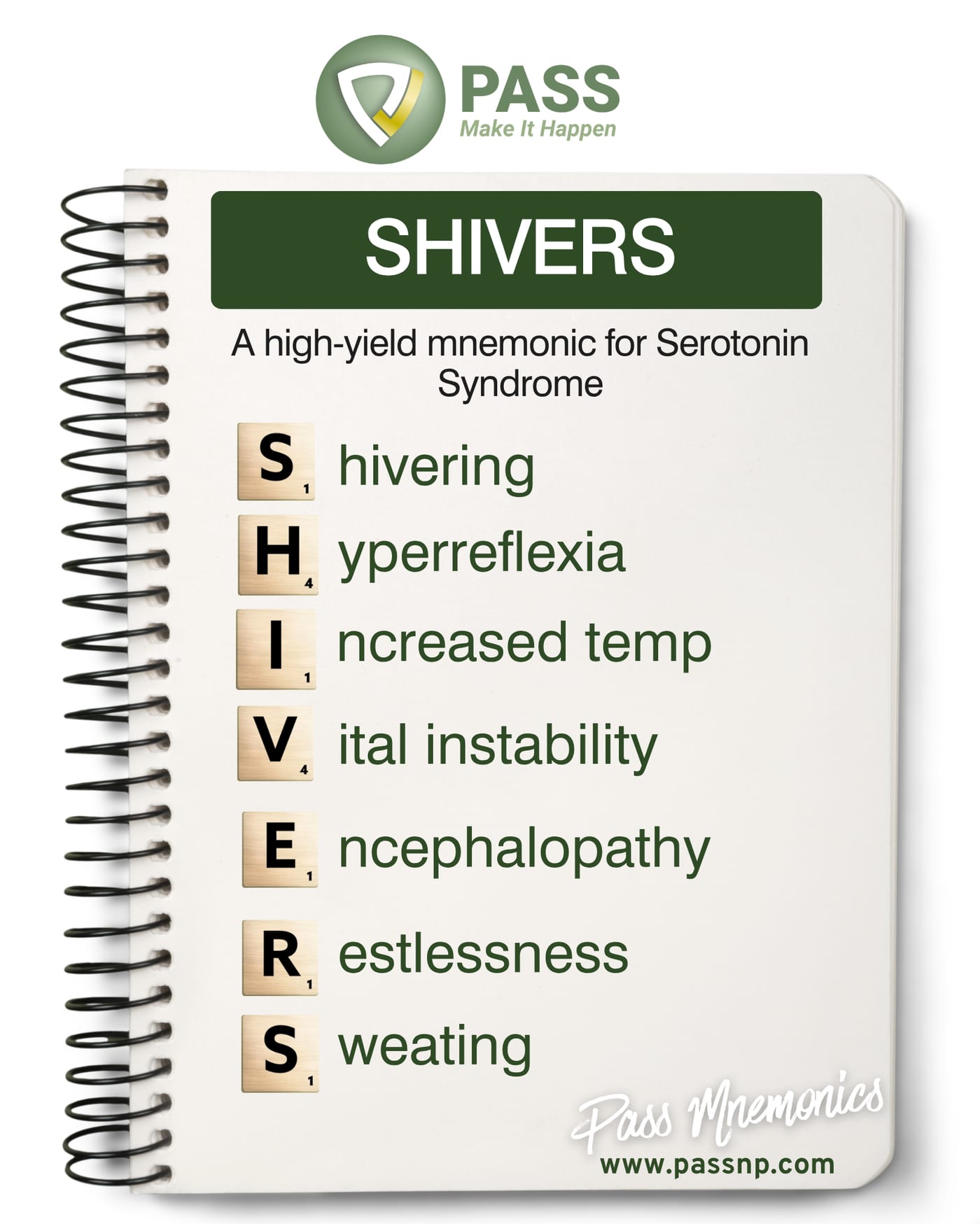
Cause
Too much serotonergic activity. Most often from combining serotonergic agents or a dose increase. Classic culprits:
- SSRIs and SNRIs
- MAOIs (especially combined with an SSRI — the boards love this combo)
- TCAs
- Triptans, tramadol, meperidine, linezolid, dextromethorphan, ondansetron
- St. John's wort and recreational MDMA
Onset
Rapid — within hours (often <24 hours) of starting, increasing, or combining a serotonergic drug. Speed is a key board clue.
Clinical Triad
- Neuromuscular excitation: clonus (especially inducible and spontaneous clonus in the lower extremities), hyperreflexia, tremor, myoclonus, muscle rigidity (less prominent than NMS).
- Autonomic instability: hyperthermia, tachycardia, hypertension, diaphoresis, dilated pupils (mydriasis), GI symptoms (diarrhea).
- Altered mental status: agitation, anxiety, confusion.
Board pearl: Clonus and hyperreflexia, lower-extremity predominant, with mydriasis and diarrhea is serotonin syndrome until proven otherwise.
Management
- Stop the offending serotonergic agent.
- Supportive care: IV fluids, cooling, benzodiazepines for agitation and muscle activity.
- Cyproheptadine (a serotonin antagonist) is the specific antidote for moderate-to-severe cases.
- Resolves relatively quickly (often within 24 hours) once the drug is stopped.
Neuroleptic Malignant Syndrome (NMS)
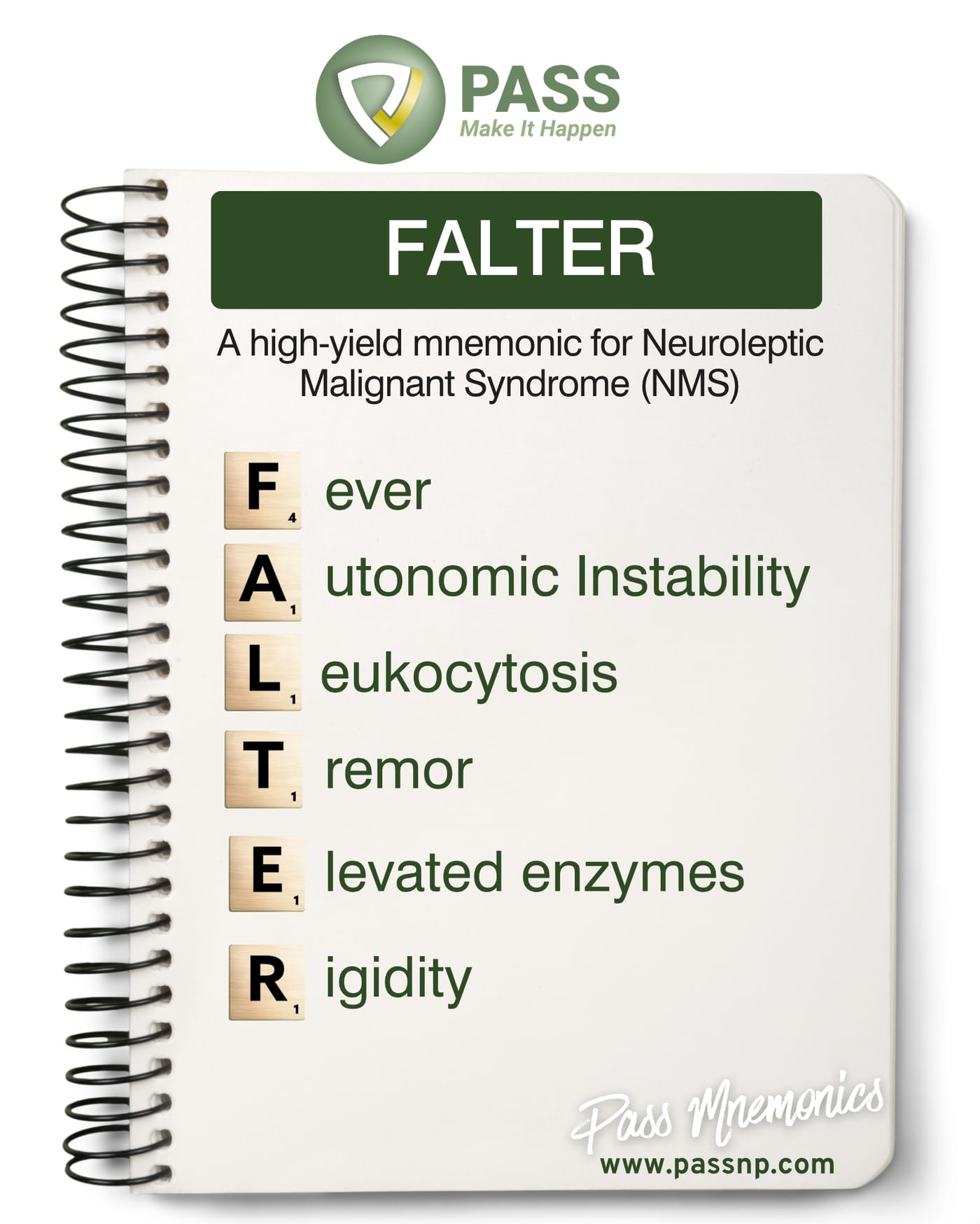
Cause
Dopamine blockade. Triggered by antipsychotics (highest risk with high-potency typicals like haloperidol, but atypicals can cause it) or by the abrupt withdrawal of dopaminergic medication (e.g., Parkinson's drugs).
Onset
Slow — over days to weeks, classically after starting or increasing an antipsychotic, or after a dose change. The gradual time course contrasts sharply with serotonin syndrome.
Classic Tetrad ("FEVER" or the four pillars)
- Fever (hyperthermia) — often very high.
- Encephalopathy / altered mental status — stupor, mutism.
- Vitals instability (autonomic dysfunction) — labile BP, tachycardia, diaphoresis.
- Elevated enzymes and rigidity — "lead-pipe" rigidity, hyporeflexia (or bradyreflexia), and a markedly elevated creatine kinase (CK) from muscle breakdown.
Board pearl: Lead-pipe rigidity, hyporeflexia, high CK, and a slow onset on an antipsychotic is NMS. Watch for rhabdomyolysis and acute kidney injury.
Management
- Stop the antipsychotic (or restart dopaminergic agent if withdrawal-induced).
- Aggressive supportive care: cooling, IV fluids, monitor for rhabdomyolysis/renal failure.
- Dantrolene (muscle relaxant) and bromocriptine (dopamine agonist) for moderate-to-severe cases.
- Recovery is slow — days to weeks.
Side-by-Side: The High-Yield Discriminators
Onset: Serotonin syndrome is rapid (hours); NMS is slow (days to weeks).
Causative drug: Serotonin syndrome from serotonergic agents (SSRIs, MAOIs, etc.); NMS from dopamine blockers (antipsychotics) or dopaminergic withdrawal.
Reflexes: Serotonin syndrome = hyperreflexia; NMS = hyporeflexia.
Muscle tone: Serotonin syndrome = clonus, myoclonus, tremor; NMS = lead-pipe rigidity.
Pupils: Serotonin syndrome = mydriasis (dilated); NMS = normal.
Bowel sounds: Serotonin syndrome = hyperactive, diarrhea; NMS = normal or decreased.
Lab clue: Both can elevate CK, but a markedly high CK with rigidity points to NMS.
Antidote: Serotonin syndrome = cyproheptadine; NMS = dantrolene + bromocriptine.
Resolution: Serotonin syndrome resolves quickly (~24 hr); NMS resolves slowly (days–weeks).
A Quick Mnemonic
- Serotonin = Shaking, twitching, hyper (clonus, hyperreflexia, fast onset).
- NMS = No movement, stiff, slow (lead-pipe rigidity, hyporeflexia, slow onset).
Why the Exam Cares
These reactions overlap with hyperthermia, autonomic instability, and altered mental status, so the vignette forces you to use the distinguishing features — onset speed, reflexes, muscle tone, and the offending drug. Both connect directly to the antidepressant and antipsychotic classes you can review in the psychopharmacology high-yield cheat sheet, and NMS ties into antipsychotic side effects. Note that serotonin syndrome risk is also why MAOIs require strict washout periods — a detail covered in the SSRI exam review.
Practice Until It's Automatic
The difference between these two syndromes should be reflex-fast on test day. The best way to get there is repetition with clinician-verified vignettes that force you to weigh onset, reflexes, and drug class. Drill the free PMHNP question bank or register for a free account to track your accuracy on emergency-recognition questions until you never miss one.
Frequently asked questions
What is the fastest way to distinguish serotonin syndrome from NMS?
Check the onset and reflexes. Serotonin syndrome has a rapid onset (hours) with hyperreflexia and clonus, while NMS has a slow onset (days) with lead-pipe rigidity and hyporeflexia. The offending drug — serotonergic agent vs. dopamine-blocking antipsychotic — confirms it.
Which drugs cause serotonin syndrome?
Serotonergic agents: SSRIs, SNRIs, MAOIs (especially combined with an SSRI), TCAs, triptans, tramadol, meperidine, linezolid, dextromethorphan, ondansetron, St. John's wort, and MDMA. It most often results from combining two serotonergic drugs.
What is the antidote for serotonin syndrome?
Cyproheptadine, a serotonin antagonist, is used for moderate-to-severe serotonin syndrome along with stopping the offending drug, supportive care, cooling, and benzodiazepines. For NMS, the specific treatments are dantrolene and bromocriptine.
Why is CK markedly elevated in NMS?
NMS causes severe, sustained lead-pipe muscle rigidity that breaks down muscle tissue, releasing creatine kinase and raising the risk of rhabdomyolysis and acute kidney injury. A very high CK with rigidity on an antipsychotic strongly suggests NMS.
Can atypical antipsychotics cause NMS?
Yes. NMS risk is highest with high-potency typical antipsychotics like haloperidol, but second-generation (atypical) antipsychotics can also cause it. NMS can also be triggered by abruptly stopping a dopaminergic medication such as a Parkinson's drug.
Related articles
Both PMHNP board blueprints broken down by domain and question count, plus the daily study system and high-yield content matrix that turn those weights into a study plan.
Since 2024, psychiatric NPs can certify through two boards: the long-standing ANCC PMHNP-BC or the newer AANPCB PMHNP-C. Here's how the two exams compare and how to choose.
PMHNP board review of perinatal mood disorders: baby blues vs postpartum depression vs psychosis, EPDS screening, SSRIs in pregnancy, and brexanolone.
Ready to practice what you just read?
Practice questions with full rationales. Sample your specialty free.
No credit card required · No subscription, no auto-renew