
Benzodiazepines & Anxiety Management: Board-Ready Protocols for PMHNPs
Benzodiazepines for the PMHNP exam: GABA-A mechanism, short vs long acting, dependence and withdrawal, overdose, special populations, and SSRI alternatives.
For the PMHNP board exam, the core benzodiazepine facts are that they potentiate GABA at the GABA-A receptor, that they are excellent for acute and short-term anxiety but carry significant dependence and withdrawal risk, and that SSRIs, SNRIs, and buspirone are first-line for chronic anxiety disorders — not benzodiazepines. Mastering when not to reach for a benzodiazepine is as testable as the pharmacology itself.
This guide gives you board-ready protocols: mechanism, half-life classes, indications, dependence and withdrawal, overdose and flumazenil cautions, special populations, and the safer first-line alternatives.
Mechanism of Action: GABA-A Potentiation
Benzodiazepines bind to a specific site on the GABA-A receptor, distinct from the GABA binding site itself. They are positive allosteric modulators: they increase the frequency of chloride-channel opening when GABA is present, enhancing inhibitory neurotransmission. The result is anxiolytic, sedative, hypnotic, muscle-relaxant, and anticonvulsant effects.
Exam contrast: benzodiazepines increase the frequency of chloride-channel opening; barbiturates increase the duration. This is why barbiturates are more dangerous in overdose — they can open the channel without GABA at high doses.
Because benzodiazepines require endogenous GABA to act, they have a relatively wide therapeutic index alone, but become dangerous when combined with other CNS depressants.
Short-Acting vs Long-Acting
Half-life drives clinical choice and is heavily tested.
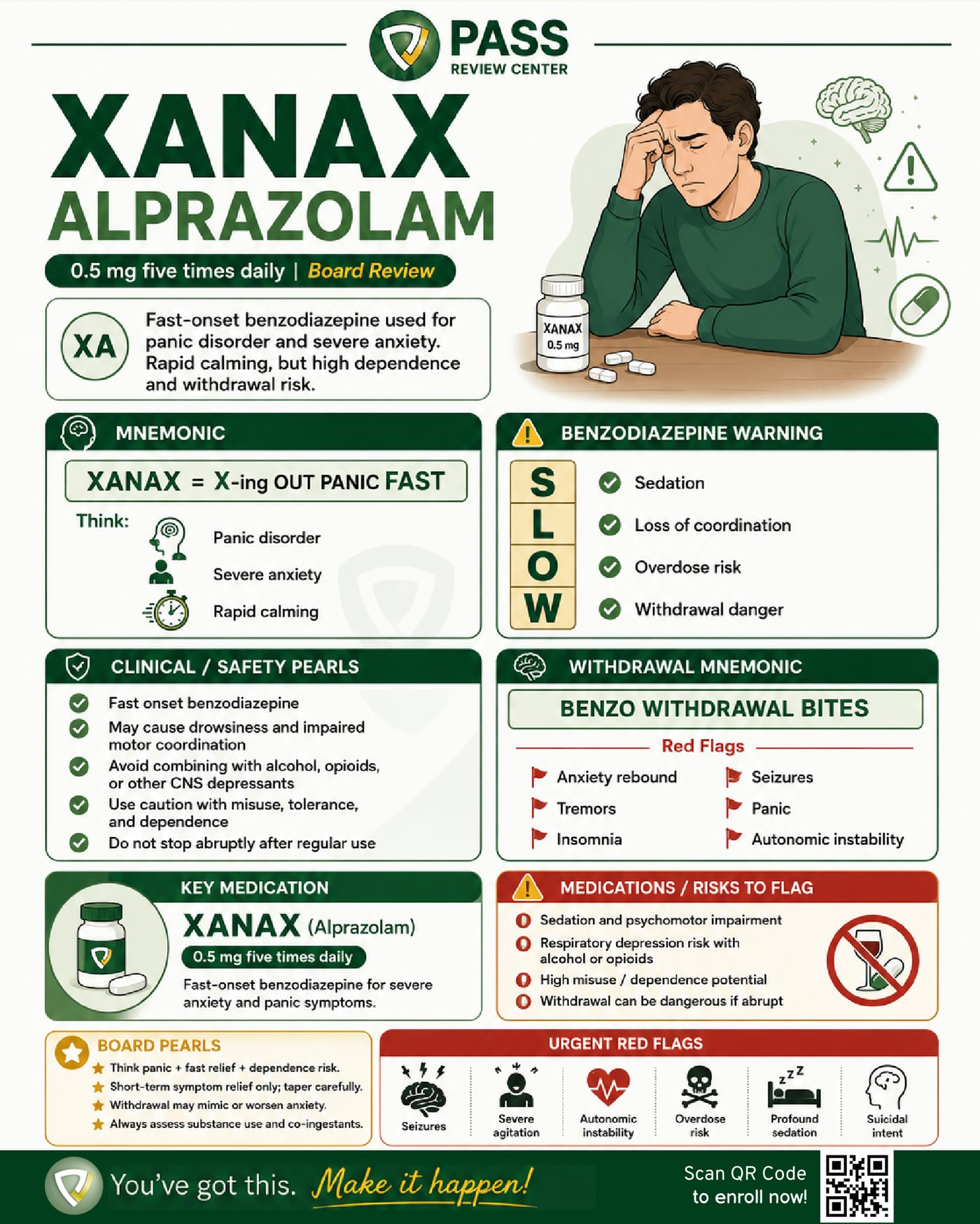
- Short- to intermediate-acting agents (for example, alprazolam, lorazepam, oxazepam) have faster offset. They are favored when you want a cleaner exit, but their rapid offset means more interdose rebound anxiety and higher dependence potential. Alprazolam in particular is associated with strong rebound and misuse.
- Long-acting agents (for example, diazepam, clonazepam, chlordiazepoxide) have prolonged effects, often via active metabolites. They give smoother coverage and are useful for tapering and for withdrawal management, but they accumulate — a real concern in the elderly and in hepatic impairment.
Metabolism pearl: lorazepam, oxazepam, and temazepam undergo only glucuronidation (no oxidative phase-I metabolism), so they are preferred in the elderly and in liver disease because they do not accumulate.
Indications
Benzodiazepines are appropriately used for:
- Acute, situational, or severe anxiety as a short-term bridge while a first-line antidepressant takes effect.
- Panic attacks for rapid relief (but not as monotherapy maintenance).
- Alcohol withdrawal, including delirium tremens — a classic exam association.
- Status epilepticus and acute seizures.
- Catatonia (lorazepam challenge).
- Procedural sedation and short-term insomnia.
They are not first-line for generalized anxiety disorder, social anxiety disorder, PTSD (often harmful here), or long-term maintenance.
Dependence, Tolerance, and Withdrawal
This is the highest-yield safety domain. Benzodiazepines are Schedule IV controlled substances and produce both physiologic dependence and tolerance.
- Tolerance develops to sedative and hypnotic effects; anxiolytic tolerance is more variable.
- Withdrawal can be dangerous and includes anxiety, insomnia, tremor, diaphoresis, and — in severe cases — seizures and delirium, mirroring alcohol withdrawal because both act on GABA.
- Withdrawal onset depends on half-life: short-acting agents produce earlier, more intense withdrawal; long-acting agents produce later, more protracted withdrawal.
- Never stop abruptly after sustained use. Taper gradually, sometimes by converting to a long-acting agent and reducing slowly.
Board pearl: a patient on chronic alprazolam who stops suddenly is at risk for seizures. The intervention is a slow taper, not an abrupt discontinuation.
Overdose and Flumazenil Cautions
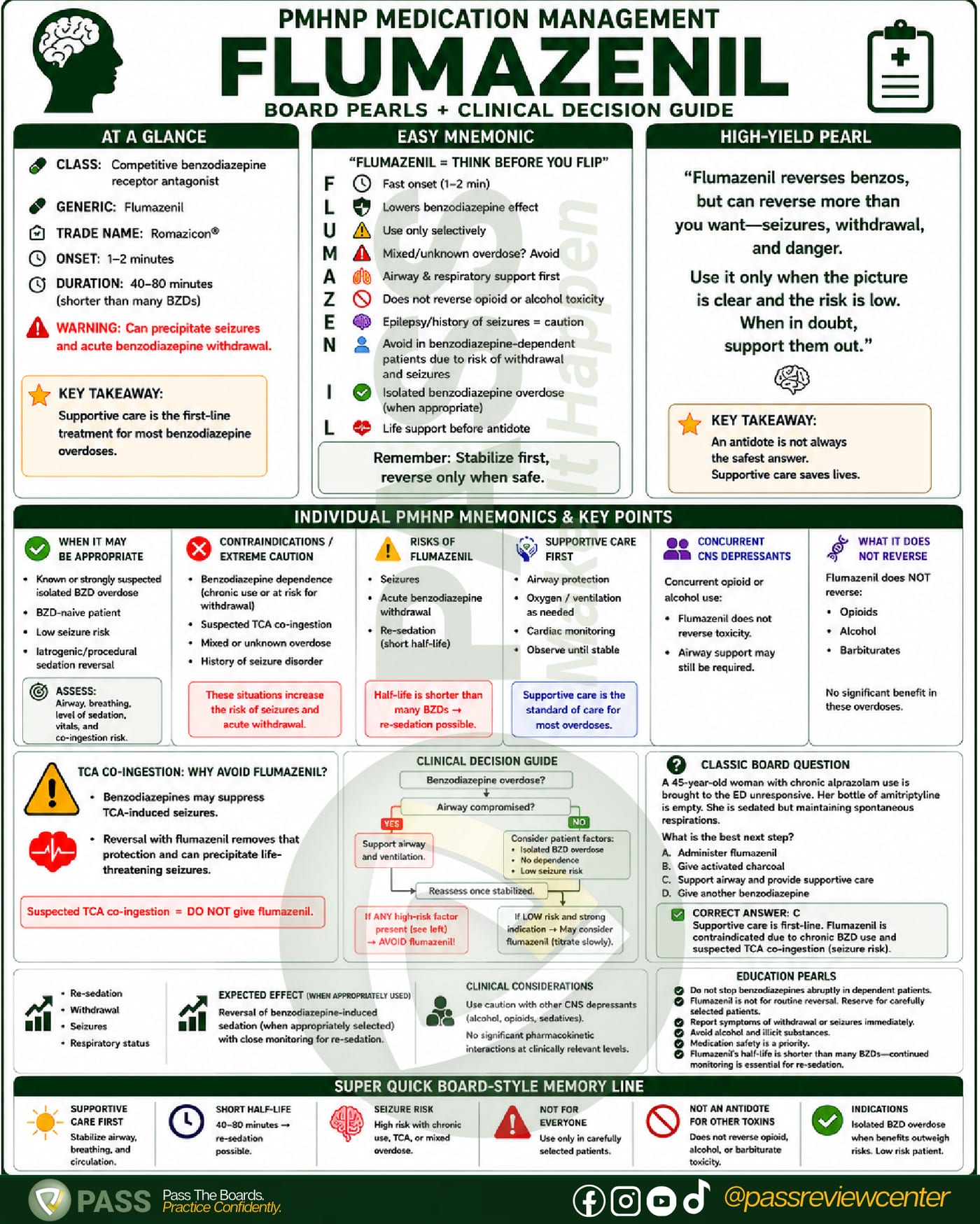
Benzodiazepine overdose alone usually causes sedation, ataxia, and slurred speech but is rarely fatal in isolation. Death typically occurs with co-ingestion of other CNS depressants — opioids or alcohol — which produce synergistic respiratory depression.
Flumazenil is a competitive benzodiazepine-receptor antagonist that reverses sedation, but the exam wants you to know its dangers:
- In a benzodiazepine-dependent patient, flumazenil can precipitate acute withdrawal and seizures.
- It can unmask seizures in mixed overdoses (e.g., with tricyclic antidepressants).
- For these reasons, flumazenil is used cautiously and selectively, not routinely. Supportive care and airway management are the mainstays of overdose treatment.
Special Populations
Elderly
Benzodiazepines appear on the Beers Criteria as potentially inappropriate in older adults. They increase the risk of falls, fractures, cognitive impairment, delirium, and motor vehicle accidents. When unavoidable, prefer glucuronidated agents (lorazepam, oxazepam, temazepam), use the lowest dose, and limit duration.
Pregnancy and lactation
Benzodiazepines cross the placenta. Use raises concerns about neonatal sedation, hypotonia ("floppy baby"), and withdrawal symptoms in the newborn with chronic third-trimester use. Weigh risks and benefits carefully, prefer non-pharmacologic and first-line antidepressant strategies where possible, and consult current obstetric and prescribing references.
Substance use history
In patients with opioid or alcohol use disorder, benzodiazepines compound respiratory-depression risk and carry high misuse potential. Favor non-controlled alternatives. See our review of MAT for substance use disorder for managing these comorbid patients.
First-Line Alternatives for Chronic Anxiety
The exam reliably rewards choosing safer maintenance therapy.
- SSRIs and SNRIs are first-line for generalized anxiety disorder, panic disorder, social anxiety disorder, and PTSD. They take several weeks to work, so a brief benzodiazepine bridge is sometimes reasonable while waiting. Note that SSRIs can transiently increase anxiety on initiation — start low and go slow. See our SSRI exam review for details.
- Buspirone is a 5-HT1A partial agonist with no dependence, no sedation, and no abuse potential. It is useful for generalized anxiety disorder but has delayed onset (one to several weeks), is not effective for acute anxiety or panic, and is not interchangeable with a benzodiazepine for PRN use.
- Hydroxyzine, an antihistamine, is an option for short-term anxiety without dependence liability.
- Psychotherapy, especially cognitive behavioral therapy, is first-line and should accompany pharmacotherapy.
Reminder: This article supports board preparation only. Confirm dosing, contraindications, and population-specific risks with current FDA prescribing information and clinical guidelines before treating any patient.
Board-Ready Protocol Summary
When a vignette describes acute, severe, or situational anxiety, or alcohol withdrawal, a benzodiazepine bridge is reasonable. When the stem describes a chronic anxiety disorder, the answer is an SSRI, SNRI, or buspirone — and benzodiazepines become the wrong choice. When you see an elderly patient, think falls and Beers Criteria. When you see abrupt discontinuation after long-term use, think seizure risk and slow taper. And when you see flumazenil in a dependent patient, think precipitated withdrawal and seizures.
Keep building your psychopharm foundation with our high-yield psychopharmacology review and the complete PMHNP-BC exam guide.
Want to drill these distinctions until they are automatic? Start with a free diagnostic assessment, then practice verified questions at PASSNP. Create your free account to begin.
Frequently asked questions
How do benzodiazepines work?
Benzodiazepines are positive allosteric modulators at the GABA-A receptor. They bind a site distinct from GABA and increase the frequency of chloride-channel opening, enhancing inhibitory neurotransmission. This produces anxiolytic, sedative, hypnotic, muscle-relaxant, and anticonvulsant effects.
Why aren't benzodiazepines first-line for chronic anxiety?
Because of dependence, tolerance, withdrawal risk, cognitive and fall risk, and misuse potential. SSRIs, SNRIs, and buspirone are first-line for generalized anxiety, panic, social anxiety, and PTSD. Benzodiazepines are best reserved for short-term or acute use as a bridge.
Which benzodiazepines are safest in the elderly and in liver disease?
Lorazepam, oxazepam, and temazepam are metabolized only by glucuronidation and have no active metabolites, so they do not accumulate. They are preferred in older adults and in hepatic impairment, though benzodiazepines remain on the Beers Criteria as potentially inappropriate in the elderly.
Is flumazenil safe to use for benzodiazepine overdose?
Flumazenil reverses benzodiazepine sedation but can precipitate acute withdrawal and seizures in dependent patients and can unmask seizures in mixed overdoses. It is used cautiously and selectively. Supportive care and airway management are the mainstays of overdose treatment.
How is buspirone different from a benzodiazepine?
Buspirone is a 5-HT1A partial agonist with no dependence, sedation, or abuse potential, but it has a delayed onset of one to several weeks and does not treat acute anxiety or panic. It cannot be used as a PRN benzodiazepine substitute.
What happens if a patient stops benzodiazepines abruptly?
Abrupt discontinuation after sustained use can cause anxiety, insomnia, tremor, autonomic instability, and in severe cases seizures and delirium, similar to alcohol withdrawal. Benzodiazepines must be tapered gradually rather than stopped suddenly.
Related articles
Both PMHNP board blueprints broken down by domain and question count, plus the daily study system and high-yield content matrix that turn those weights into a study plan.
Since 2024, psychiatric NPs can certify through two boards: the long-standing ANCC PMHNP-BC or the newer AANPCB PMHNP-C. Here's how the two exams compare and how to choose.
PMHNP board review of perinatal mood disorders: baby blues vs postpartum depression vs psychosis, EPDS screening, SSRIs in pregnancy, and brexanolone.
Ready to practice what you just read?
Practice questions with full rationales. Sample your specialty free.
No credit card required · No subscription, no auto-renew