
PMHNP-BC Exam Guide 2026: Format, Blueprint, Passing Score & How to Pass
The complete 2026 PMHNP-BC exam guide: ANCC format (175 questions, 3.5 hours), content blueprint, scaled passing score, eligibility, and a study roadmap.
The PMHNP-BC exam is the ANCC's psychiatric-mental health nurse practitioner board certification: 175 questions (150 scored plus 25 unscored pretest items) delivered in a 3.5-hour computer-based test. To pass, you need a scaled score of 350 on a 0-to-500 scale, and the modern exam leans heavily on applied clinical judgment rather than rote recall. This guide walks through every part of the exam, what it tests, and a high-level roadmap to get you ready.
Whether you are months out or in your final weeks, use this as your hub. Each section links to deeper resources, and you can start practicing immediately with a free PMHNP question bank.
What Is the PMHNP-BC Exam?
The PMHNP-BC credential is awarded by the American Nurses Credentialing Center (ANCC), the certification arm of the American Nurses Association. "PMHNP-BC" stands for Psychiatric-Mental Health Nurse Practitioner — Board Certified. It is the standard entry-to-practice certification for nurse practitioners who diagnose and treat psychiatric and mental health conditions across the lifespan.
The exam validates that you can safely practice as a psychiatric NP: assessing patients, formulating differential diagnoses grounded in DSM-5-TR, prescribing and managing psychotropic medication, delivering psychotherapeutic interventions, and coordinating care within legal and ethical boundaries.
This guide covers the ANCC PMHNP-BC. Since 2024, psychiatric-mental health NPs can also certify through the AANPCB PMHNP-C, so there are now two board options — see ANCC vs. AANP for Psych NPs for how the two exams compare.
Exam Format: Questions, Time, and Delivery
The PMHNP-BC exam is a fixed-length, computer-based test administered at Prometric testing centers (and through approved remote-proctoring options).
- Total questions: 175 items.
- Scored questions: 150 items count toward your score.
- Pretest questions: 25 unscored items are mixed in to be field-tested for future exams. You cannot tell which is which, so treat every question as if it counts.
- Time limit: 3.5 hours (210 minutes) total.
- Question style: Primarily four-option multiple choice, with a growing share of "alternate" formats — multiple-response (select-all-that-apply), drag-and-drop ordering, and scenario-based items.
That 3.5-hour window for 175 questions works out to roughly 72 seconds per question on average (210 minutes ÷ 175). Most candidates finish with time to spare, but pacing still matters — see How Many Questions Are on the PMHNP Exam? for the full pacing math.
The Content Blueprint (Test Content Outline)
The ANCC organizes the PMHNP-BC exam around a published Test Content Outline. The exact category weights are updated periodically, so always confirm the current outline on the ANCC website. The current blueprint covers five domains:
- Scientific Foundation (22%): psychopathology, neurobiology, pharmacokinetics and pharmacodynamics, growth and development, and the evidence base for psychiatric care.
- Advanced Practice Skills (27%): comprehensive psychiatric evaluation, mental status exam, risk assessment (suicide, violence, self-harm), screening tools, and diagnostic reasoning skills.
- Diagnosis & Treatment (22%): DSM-5-TR-aligned differential diagnosis, psychopharmacology, crisis intervention, and integrated care planning.
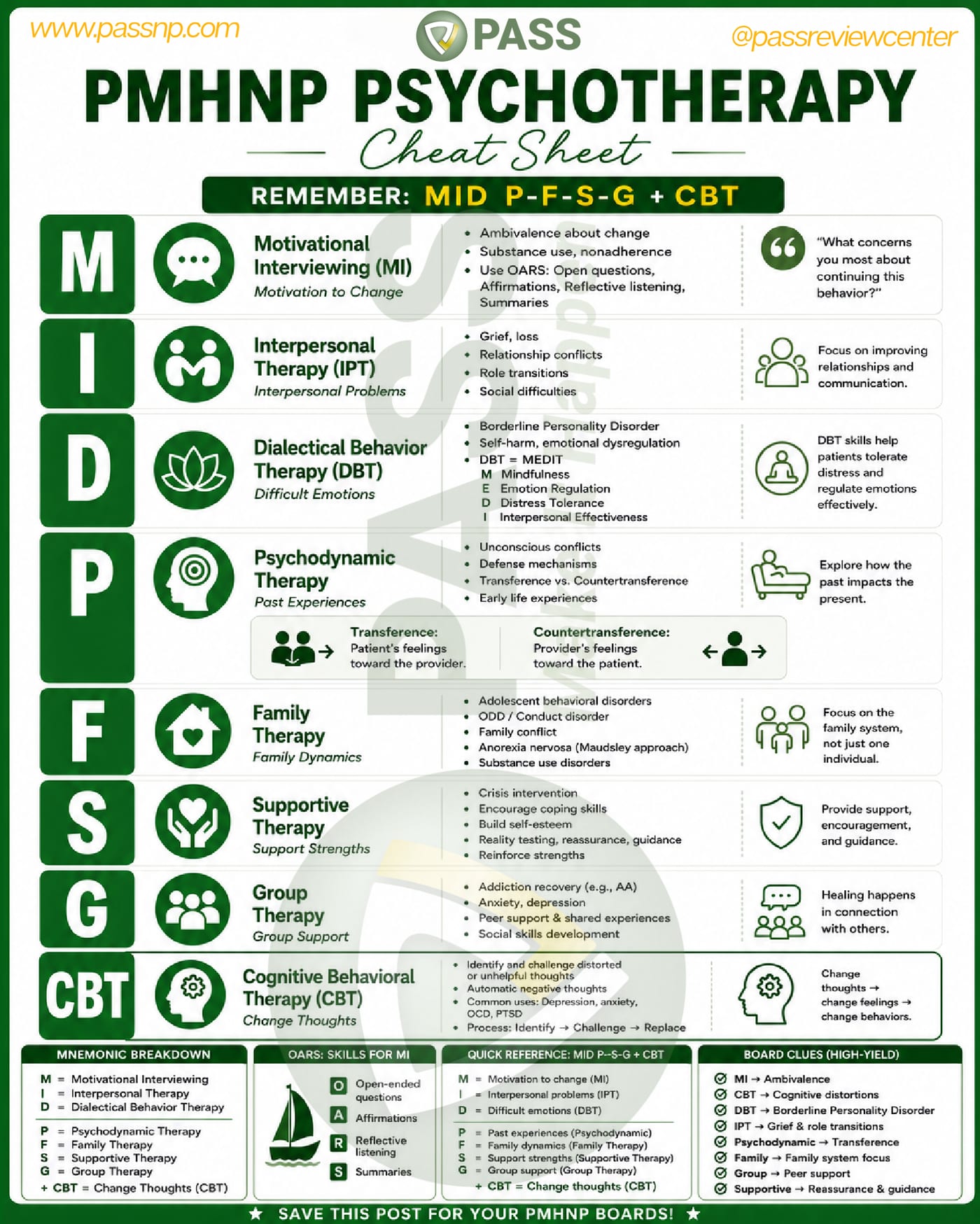
- Psychotherapy & Related Theories (11%): psychotherapy modalities (CBT, motivational interviewing, supportive therapy) and the theoretical frameworks behind them.
- Ethics, Legal Principles & Cultural Care (17%): ethics, scope of practice, legal issues (involuntary commitment, capacity, mandatory reporting), cultural humility, and quality improvement.
Across all domains, the most heavily tested clinical content tends to be psychopharmacology and diagnosis — the bread and butter of daily psychiatric NP work. Build a strong foundation there with our high-yield psychopharmacology guide.
What the Exam Actually Tests
The blueprint also maps items across the steps of the nursing process and increasingly emphasizes clinical judgment. Expect questions that don't just ask "what is the mechanism of action of sertraline" but rather give you a patient vignette and ask what you would do next: which medication to start, when to switch, how to manage an emerging side effect, or how to respond to a safety risk.
This shift toward applied reasoning is the single biggest theme in recent exam updates. We break it down fully in What's New on the 2026 PMHNP Exam.
Scoring and the Passing Score
The ANCC reports PMHNP-BC results on a scaled score from 0 to 500, with 350 as the passing cut score. Your raw number of correct answers is converted to this scaled score through a statistical equating process, which keeps the standard consistent even if one form of the exam is slightly harder than another.
A few things to understand about scoring:
- Only the 150 scored items count. The 25 pretest items have no effect on your result.
- There is no penalty for guessing. Always answer every question — a blank is wrong, but a guess has a real chance of being right.
- You get pass/fail plus diagnostic feedback. If you do not pass, the score report shows your relative performance by content area so you know where to focus.
Because of scaling, there is no single "percent correct" that guarantees a pass. Rather than chase a magic number, focus on consistent mastery across domains. For more on interpreting performance data, read PMHNP Exam Pass Rates: What the Numbers Really Mean.
Eligibility Requirements
To sit for the PMHNP-BC exam, the ANCC generally requires:
- An active, unencumbered RN license in the US or its equivalent in another country.
- A master's, post-graduate certificate, or DNP from a psychiatric-mental health nurse practitioner program accredited by CCNE or ACEN.
- A minimum of 500 faculty-supervised clinical hours in psychiatric-mental health NP practice across the lifespan, completed within your graduate program.
- Specific graduate-level coursework in advanced physiology/pathophysiology, advanced health assessment, and advanced pharmacology (the "3 Ps"), plus content in psychiatric assessment, diagnosis, psychotherapy, and psychopharmacology.
Requirements can change, so verify current eligibility directly with the ANCC before you apply. Once approved, your authorization-to-test window is typically 90 days.
A High-Level Study Roadmap
Most candidates do well with a focused 6-to-12 week plan, scaled to how recently they graduated and how much they retained. Here is the arc most successful test-takers follow:
- Take a diagnostic baseline. Before you study, find out where you stand. A short free readiness assessment shows which domains are weak so you don't waste time reviewing what you already know.
- Build the clinical core. Spend the bulk of your time on diagnosis (DSM-5-TR criteria, differentials, red-flag presentations) and psychopharmacology (drug classes, mechanisms, side effects, monitoring, and switching strategies). These two areas carry the most weight.
- Layer in role, ethics, and legal content. Scope of practice, involuntary holds, capacity, confidentiality, and cultural considerations are reliable points if you study them deliberately.
- Drill questions every day. The exam rewards application, so passive reading is not enough. Practice with case-based, clinician-verified questions and read every rationale — including for the answers you got right.
- Simulate the real thing. In your final weeks, do timed blocks that mirror the 175-question, 3.5-hour format so test day feels familiar.
For a day-by-day version of this arc, follow our 30-day PMHNP study plan. If you want the mindset and habits that separate first-time passers, read how to pass the PMHNP exam on your first try.
Test-Day Logistics and Tips
- Arrive early with the required government-issued ID; latecomers may be turned away.
- Use the tutorial time to get comfortable with the interface before the clock starts.
- Flag and move on. Don't burn five minutes on one hard item — mark it, answer it provisionally, and return if time allows.
- Trust your first instinct unless you find a clear reason to change; second-guessing tends to cost more points than it saves.
- Manage stamina. Three and a half hours is long. Use any permitted breaks, hydrate, and reset your focus.
Put It All Together
The PMHNP-BC exam is challenging but very passable with the right preparation: master diagnosis and psychopharmacology, practice applied clinical-judgment questions daily, and simulate the format before test day. The candidates who struggle are usually the ones who relied on memorization instead of reasoning through patient scenarios.
The most effective way to build that reasoning is repetition with high-quality, clinician-verified questions that explain why each answer is right or wrong. Start drilling today with our free PMHNP question bank, or create a free account to track your progress across every domain on the blueprint.
Frequently asked questions
How many questions are on the PMHNP-BC exam?
The PMHNP-BC exam has 175 questions total: 150 scored items and 25 unscored pretest items. You have 3.5 hours to complete it.
What is the passing score for the PMHNP-BC exam?
The ANCC reports results on a scaled score from 0 to 500, and you must reach a scaled score of 350 to pass. Only the 150 scored items count toward this number.
Who administers the PMHNP-BC certification?
The American Nurses Credentialing Center (ANCC) administers the PMHNP-BC exam. It is the standard board certification for psychiatric-mental health nurse practitioners.
What does the PMHNP exam focus on most?
Psychopharmacology and DSM-5-TR-based diagnosis are the most heavily tested clinical areas, increasingly delivered as case-based clinical-judgment questions rather than simple recall.
How long should I study for the PMHNP-BC exam?
Most candidates prepare effectively in 6 to 12 weeks, depending on how recently they graduated. A focused 30-day plan can work for recent grads who study consistently and practice questions daily.
Is there a penalty for guessing on the PMHNP exam?
No. There is no penalty for incorrect answers, so you should answer every question. A blank is always wrong, but a guess has a real chance of being correct.
Related articles
Both PMHNP board blueprints broken down by domain and question count, plus the daily study system and high-yield content matrix that turn those weights into a study plan.
Since 2024, psychiatric NPs can certify through two boards: the long-standing ANCC PMHNP-BC or the newer AANPCB PMHNP-C. Here's how the two exams compare and how to choose.
PMHNP board review of perinatal mood disorders: baby blues vs postpartum depression vs psychosis, EPDS screening, SSRIs in pregnancy, and brexanolone.
Ready to practice what you just read?
Practice questions with full rationales. Sample your specialty free.
No credit card required · No subscription, no auto-renew