
GAD vs. Panic Disorder: PMHNP Board Review
PMHNP board review distinguishing GAD from panic disorder: DSM-5-TR criteria, first-line SSRIs/SNRIs, the limits of benzodiazepines, and CBT.
Generalized anxiety disorder (GAD) is chronic, excessive worry about multiple domains for at least 6 months, whereas panic disorder is defined by recurrent, unexpected panic attacks followed by persistent worry about future attacks or maladaptive behavior change. The single highest-yield board point: GAD is pervasive, persistent worry, while panic disorder centers on discrete, abrupt attacks plus anticipatory anxiety about them. Both are first-line treated with SSRIs/SNRIs plus CBT — not standing benzodiazepines.
This review contrasts the two disorders and locks in the treatment hierarchy the exam rewards.
Epidemiology and course
Anxiety disorders are the most prevalent class of psychiatric conditions. GAD has a lifetime prevalence of roughly 5–9% and panic disorder around 2–5%, with both about twice as common in women. GAD often has an insidious onset and a chronic, waxing-and-waning course frequently complicated by comorbid depression; many patients present first to primary care with somatic complaints like fatigue, headaches, or GI distress. Panic disorder typically begins in late adolescence to the mid-30s and, untreated, can progress to agoraphobia as patients increasingly avoid situations associated with attacks. Both disorders are highly treatable, yet under-recognized because patients attribute symptoms to physical illness — a recurring theme in board vignettes where the "answer" is to recognize the psychiatric diagnosis behind a negative medical workup.
Diagnostic criteria (DSM-5-TR)
Generalized anxiety disorder
- Excessive anxiety and worry about multiple events/activities, occurring more days than not for at least 6 months.
- The worry is difficult to control.
- Associated with three or more of six symptoms (only one required in children) — mnemonic resembles "WATCHERS" but the DSM six are: restlessness/on edge, easily fatigued, difficulty concentrating, irritability, muscle tension, and sleep disturbance.
- Causes significant distress or impairment; not attributable to a substance, medical condition, or another disorder.
Panic disorder
- Recurrent, unexpected panic attacks — an abrupt surge of intense fear peaking within minutes, with four or more of 13 symptoms (palpitations, sweating, trembling, shortness of breath, choking, chest pain, nausea, dizziness, chills/heat, paresthesias, derealization/depersonalization, fear of losing control, fear of dying).
- At least one attack followed by 1 month or more of persistent concern about additional attacks or a maladaptive behavior change (e.g., avoidance) to prevent them.
- Not attributable to a substance or medical condition.
Key distinction: in panic disorder the attacks are unexpected (come "out of the blue"). Attacks that are always cued/expected point toward a phobia or another anxiety disorder, not panic disorder. Panic attacks themselves are a specifier that can occur across many disorders.
Clinical features and differential
- GAD patients describe ongoing, free-floating worry, muscle tension, and trouble relaxing — a baseline state.
- Panic disorder patients describe sudden, terrifying episodes, often with ER visits for presumed cardiac events, plus anticipatory dread between episodes.
A panic attack itself is not a diagnosis — it is an abrupt surge of intense fear or discomfort that peaks within minutes and can occur in many disorders or even in people without a disorder. DSM-5-TR therefore allows "with panic attacks" as a specifier applied to other conditions. Panic disorder additionally requires that attacks be recurrent and unexpected and that they generate persistent anticipatory worry or behavioral change. This is a high-yield distinction: a single cued panic attack during a feared social situation supports social anxiety disorder, not panic disorder.
Differential considerations:
- Agoraphobia: fear/avoidance of situations where escape is hard; frequently comorbid with panic disorder but a separate diagnosis.
- Social anxiety disorder and specific phobia: anxiety is cued by specific situations.
- Medical mimics: hyperthyroidism, pheochromocytoma, arrhythmias, asthma/COPD, and caffeine or stimulant use can produce panic-like symptoms — always screen.
- PTSD, OCD, and depression commonly co-occur (see the PTSD review and MDD review). In OCD the anxiety is driven by intrusive obsessions and relieved by compulsions; in PTSD it is anchored to a traumatic event — neither is free-floating worry or unprovoked attacks.
- Illness anxiety / somatic symptom disorders: preoccupation with having a serious disease can overlap with both GAD and panic.
A practical bedside distinction: ask what the patient worries about. The GAD patient lists many ordinary concerns (finances, family, health, work) that shift from topic to topic; the panic-disorder patient fears the next attack and the bodily sensations that herald it. The GAD patient is anxious most of the time; the panic-disorder patient is often calm between discrete, terrifying surges.
First-line treatment
Pharmacotherapy
SSRIs and SNRIs are first-line for both GAD and panic disorder.
- SSRIs: sertraline, escitalopram, paroxetine, fluoxetine.
- SNRIs: venlafaxine XR, duloxetine.
Prescribing pearls:
- Start low, go slow. Anxious and panic-disorder patients are sensitive to early activation/jitteriness; low starting doses reduce the initial anxiety spike. See the SSRI exam review.
- Onset: full anxiolytic benefit takes 4–6 weeks.
- Adequate trial and duration: continue an effective agent for at least 6–12 months after response to prevent relapse; taper slowly to avoid discontinuation symptoms.
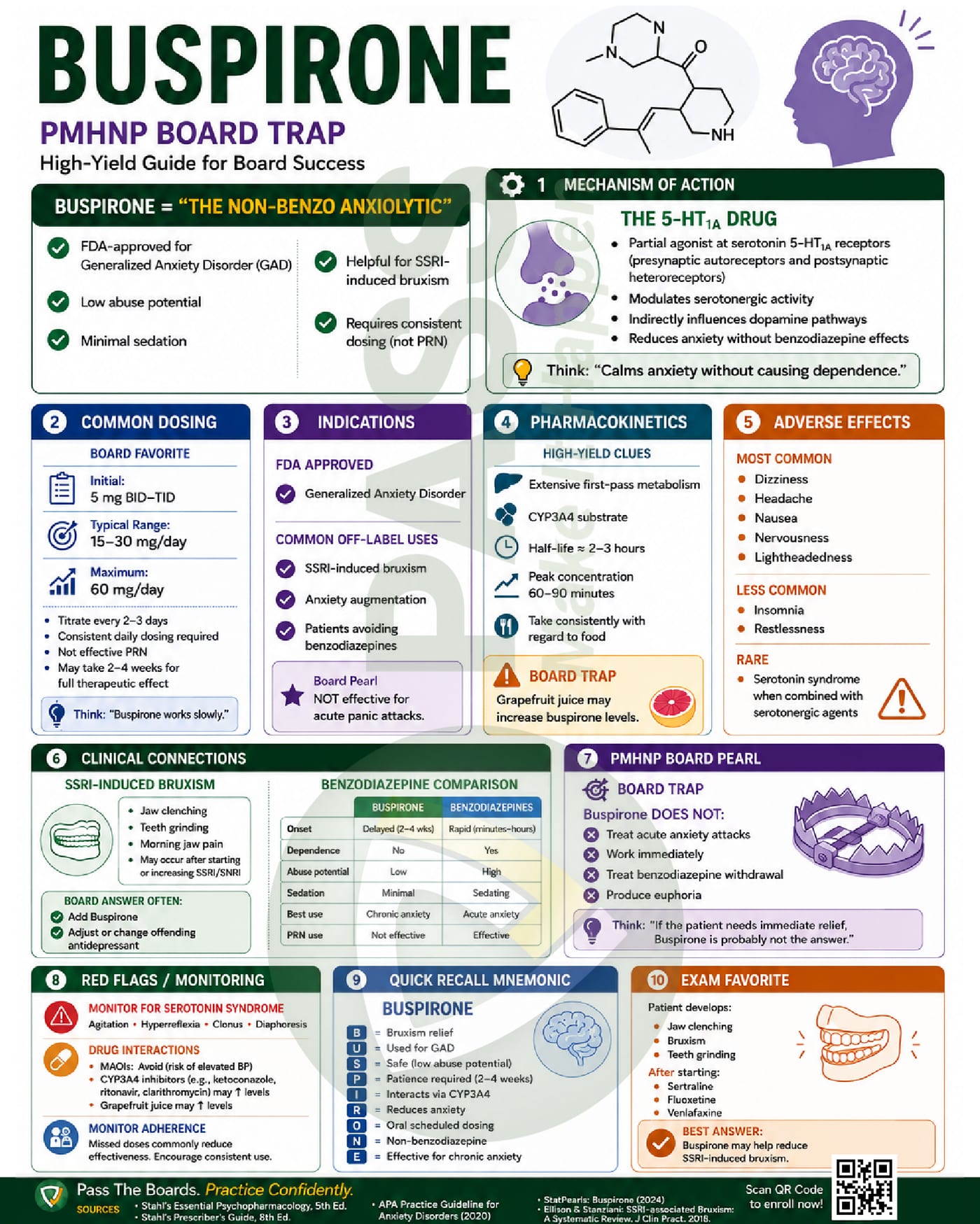
- Buspirone is an option for GAD (non-sedating, non-dependence-forming) but is ineffective for acute anxiety and panic attacks and has a delayed onset of about 2–4 weeks.
- Other options: pregabalin and hydroxyzine have evidence in GAD; pregabalin is not first-line in the US but appears on some exams.
Know the distinction tested constantly: the best long-term treatment is an SSRI or SNRI, while a benzodiazepine may be a short-term bridge only.
The role and limits of benzodiazepines
- Benzodiazepines (lorazepam, clonazepam, alprazolam) provide rapid relief and may bridge the gap while an SSRI/SNRI takes effect.
- They are not first-line for maintenance because of tolerance, dependence, sedation, cognitive impairment, and falls in older adults.
- Avoid in patients with substance use disorders; use the shortest course possible. This is a frequent exam answer: the "best long-term" choice is an SSRI/SNRI, not a benzodiazepine.
Psychotherapy
CBT is first-line and as effective as medication for both disorders, with more durable benefit after treatment ends; combination therapy is often best for moderate-to-severe presentations. Applied relaxation, mindfulness-based interventions, and acceptance-based approaches also have supporting evidence, particularly for GAD.
- GAD: cognitive restructuring, worry exposure, relaxation training.
- Panic disorder: interoceptive exposure (deliberately inducing feared bodily sensations) plus cognitive restructuring of catastrophic misinterpretations. Psychoeducation that panic attacks are physiologically harmless and self-limited is itself therapeutic and reduces anticipatory anxiety.
Managing comorbidity
Depression co-occurs in a large share of anxiety patients; an SSRI/SNRI conveniently treats both. Screen for substance and alcohol use, which patients often adopt as self-medication and which can both mimic and worsen anxiety. In panic disorder, a thorough but non-excessive medical workup is appropriate — repeated reassurance-seeking and unnecessary cardiac testing can reinforce health anxiety. Caffeine reduction and sleep hygiene are practical adjuncts the boards may reward.
High-yield board pearls
- GAD = 6 months of excessive, hard-to-control worry; panic disorder = recurrent unexpected attacks + 1 month of anticipatory worry or behavior change.
- SSRIs/SNRIs plus CBT are first-line for both.
- Start antidepressants low in panic disorder to avoid activation that mimics an attack.
- Benzodiazepines are short-term bridges, not maintenance therapy.
- Buspirone helps GAD but does nothing for an acute panic attack.
- Interoceptive exposure is the signature CBT technique for panic disorder.
Common exam traps
- Choosing a benzodiazepine as the best long-term treatment. The maintenance answer is almost always an SSRI/SNRI.
- Using buspirone for panic disorder or acute anxiety. It is for chronic GAD only and has delayed onset.
- Missing medical mimics like hyperthyroidism or stimulant use behind "panic" symptoms.
- Confusing expected and unexpected attacks. Panic disorder requires unexpected attacks; always-cued attacks suggest a phobia.
- Forgetting low-and-slow dosing and counseling about early activation in panic patients.
- Diagnosing GAD with under 6 months of symptoms — the duration is required.
Clinical decisions should follow current guidelines and individualized assessment; this content is educational.
Practice anxiety-disorder questions on PASSNP
The GAD-vs-panic distinction and the benzodiazepine trap appear on virtually every PMHNP exam. PASSNP's verified question bank reinforces both with detailed rationales. Take a free diagnostic assessment, explore the PMHNP question bank, or register for free to start practicing anxiety-disorder items now.
Frequently asked questions
How do GAD and panic disorder differ?
GAD is chronic, excessive, hard-to-control worry about multiple domains lasting at least 6 months with physical symptoms like muscle tension and restlessness. Panic disorder is defined by recurrent, unexpected panic attacks that peak within minutes, followed by at least 1 month of persistent worry about future attacks or maladaptive avoidance. GAD is pervasive worry; panic disorder is discrete attacks.
What is first-line treatment for GAD and panic disorder?
SSRIs and SNRIs combined with cognitive behavioral therapy are first-line for both disorders. Full anxiolytic benefit from medication takes about 4 to 6 weeks. In panic disorder, start the antidepressant at a low dose to avoid early activation that can mimic a panic attack.
Why are benzodiazepines not first-line for anxiety disorders?
Benzodiazepines provide rapid relief and can bridge the time until an SSRI or SNRI takes effect, but they carry risks of tolerance, dependence, sedation, cognitive impairment, and falls in older adults. They are avoided in patients with substance use disorders. For long-term management, the best answer is an SSRI or SNRI, not a benzodiazepine.
What is interoceptive exposure?
Interoceptive exposure is a CBT technique for panic disorder in which the patient deliberately induces feared bodily sensations, such as hyperventilation or spinning, to reduce fear of those sensations. It is paired with cognitive restructuring of catastrophic misinterpretations of physical symptoms.
Is buspirone useful for panic attacks?
No. Buspirone is an option for generalized anxiety disorder because it is non-sedating and non-dependence-forming, but it has a delayed onset and is ineffective for acute anxiety and panic attacks. Choosing buspirone for panic disorder is a common exam trap.
Related articles
Both PMHNP board blueprints broken down by domain and question count, plus the daily study system and high-yield content matrix that turn those weights into a study plan.
Since 2024, psychiatric NPs can certify through two boards: the long-standing ANCC PMHNP-BC or the newer AANPCB PMHNP-C. Here's how the two exams compare and how to choose.
PMHNP board review of perinatal mood disorders: baby blues vs postpartum depression vs psychosis, EPDS screening, SSRIs in pregnancy, and brexanolone.
Ready to practice what you just read?
Practice questions with full rationales. Sample your specialty free.
No credit card required · No subscription, no auto-renew