
Eating Disorders: PMHNP Board Review
PMHNP board review of eating disorders: anorexia vs bulimia vs binge-eating, refeeding syndrome, electrolytes, fluoxetine, and bupropion contraindication.
Eating disorders are serious psychiatric illnesses — anorexia nervosa carries the highest mortality of any mental health condition — driven by both medical complications and suicide. The two highest-yield board points: fluoxetine is the only FDA-approved medication for bulimia nervosa, and bupropion is contraindicated in patients with bulimia or anorexia because of seizure risk. A close third: watch for refeeding syndrome when nutritionally restoring a severely malnourished patient.
This review covers the DSM-5-TR distinctions, the medical complications you must recognize, and the treatment hierarchy.
Epidemiology and risk factors
Eating disorders typically begin in adolescence and young adulthood and disproportionately affect females, though they occur in all genders and are likely underdiagnosed in males and older adults. Risk factors include perfectionism, low self-esteem, history of dieting, trauma, family history, and participation in appearance- or weight-focused activities (gymnastics, dance, wrestling). Anorexia nervosa carries the highest mortality of any psychiatric illness, driven by both medical complications and a markedly elevated suicide rate. Comorbidity is the rule rather than the exception: depression, anxiety disorders, OCD, and substance use disorders are common, and personality features overlap heavily. Because patients often minimize or conceal symptoms, the board frequently provides indirect clues — laboratory abnormalities, vital-sign changes, or physical exam findings — rather than a self-reported complaint. Building the habit of reading those clues is essential for the vignette-style questions.
Diagnostic criteria (DSM-5-TR)
Anorexia nervosa
- Restriction of energy intake leading to significantly low body weight for age, sex, and health.
- Intense fear of gaining weight or persistent behavior that interferes with weight gain.
- Disturbance in body image or denial of the seriousness of low weight.
- Note: DSM-5 (2013) removed the amenorrhea criterion, and DSM-5-TR keeps it out — a frequently tested update.
- Subtypes: restricting type and binge-eating/purging type. Severity is graded by BMI.
Bulimia nervosa
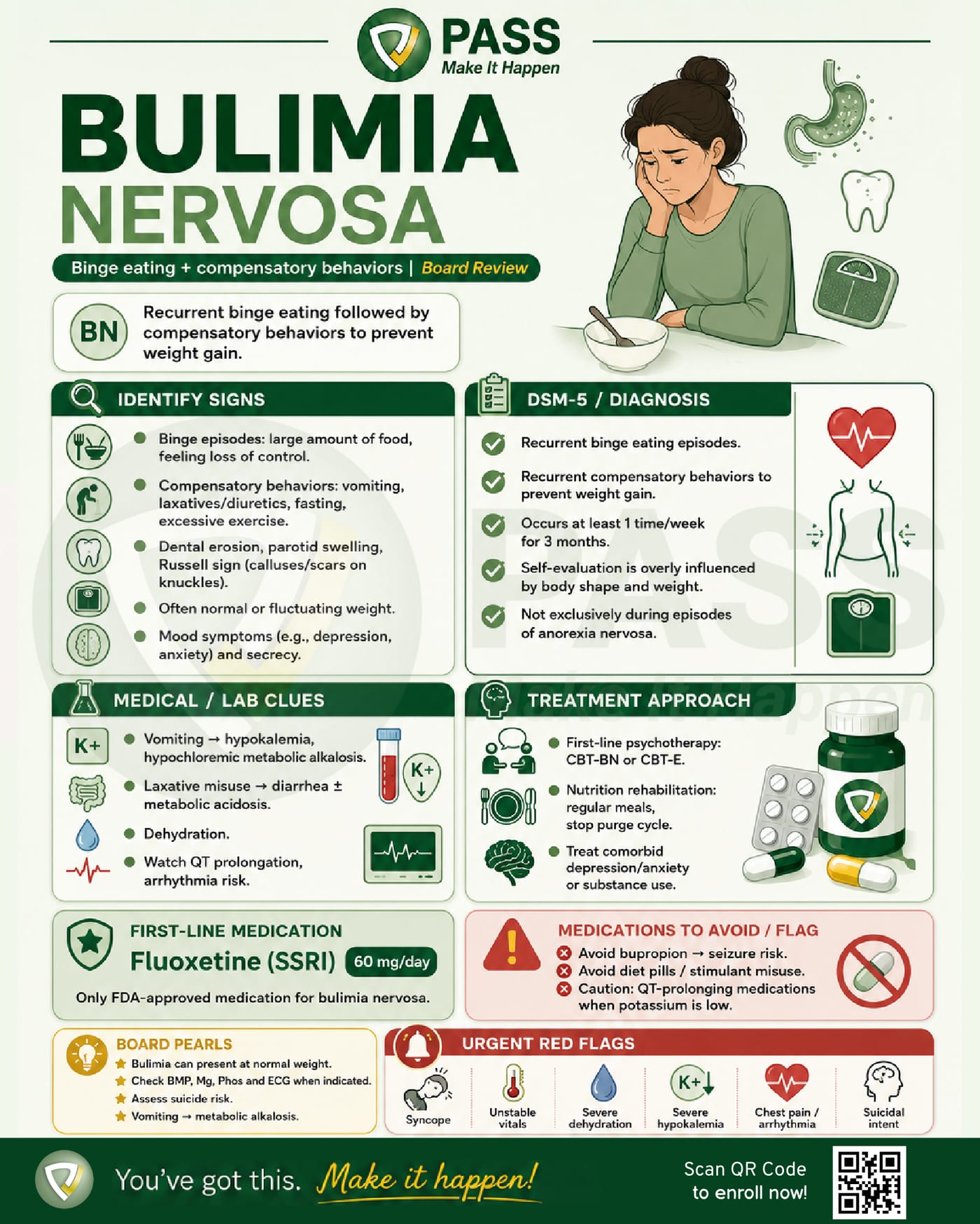
- Recurrent binge eating (eating an objectively large amount with a sense of loss of control).
- Recurrent compensatory behaviors (self-induced vomiting, laxatives, diuretics, fasting, excessive exercise).
- Both occur, on average, at least once a week for 3 months.
- Self-evaluation unduly influenced by body shape/weight.
- Crucially, the behaviors do not occur exclusively during anorexia. Patients with bulimia are often normal weight or overweight.
Binge-eating disorder (BED)
- Recurrent binge eating with marked distress, but no compensatory behaviors.
- At least once a week for 3 months.
- BED is the most common eating disorder and is associated with obesity.
Clinical features and differential
Distinguishing the three on a stem:
- Anorexia: Underweight, restrictive, body-image disturbance. May purge but is defined by low weight.
- Bulimia: Usually normal/overweight, binge plus compensatory behavior, not underweight.
- BED: Binge without compensation, often obese.
Physical exam clues are heavily tested:
- Lanugo, bradycardia, hypotension, hypothermia, amenorrhea suggest anorexia.
- Russell's sign (calluses on knuckles), parotid gland enlargement, and dental erosion suggest self-induced vomiting in bulimia.
Differential includes medical causes of weight loss (malignancy, hyperthyroidism, IBD), depression with appetite change, and avoidant/restrictive food intake disorder (ARFID — restriction without body-image disturbance).
Medical complications — the most testable domain
Refeeding syndrome
When a severely malnourished patient is fed, a carbohydrate-driven insulin surge shifts phosphate, potassium, and magnesium intracellularly.
- Hallmark: hypophosphatemia. Also hypokalemia and hypomagnesemia.
- Can cause cardiac arrhythmia, heart failure, respiratory failure, and death.
- Prevention: start feeding slowly (low calories), monitor and replete electrolytes — especially phosphate — and supplement thiamine before/with carbohydrates.
Electrolyte and acid-base findings
- Self-induced vomiting: Loss of gastric acid causes hypokalemic, hypochloremic metabolic alkalosis. Hypokalemia raises arrhythmia risk.
- Laxative abuse: Can cause metabolic acidosis and hypokalemia.
- Cardiac risk: QTc prolongation from electrolyte derangement is a leading cause of death; ECG monitoring is essential in severe cases.
Medical stabilization and a higher level of care are indicated for severe bradycardia, unstable vitals, dangerous electrolytes, or acute refeeding risk.
Other complications by system
Beyond electrolytes, board questions probe multisystem effects of chronic restriction and purging:
- Cardiac: Bradycardia, hypotension, and QTc prolongation increase arrhythmia and sudden-death risk; mitral valve prolapse and pericardial effusion can occur.
- Endocrine/bone: Hypothalamic suppression causes amenorrhea, low estrogen, and osteoporosis/osteopenia — bone loss may be irreversible. Low T3 ("euthyroid sick" pattern) is common.
- GI: Delayed gastric emptying, constipation, and, with purging, esophagitis or rare esophageal rupture (Boerhaave).
- Hematologic: Anemia, leukopenia, and thrombocytopenia from marrow suppression.
These findings often signal severity and the need for inpatient or medical admission, which is a recurring decision point on the exam.
Levels of care and monitoring
Deciding where to treat is itself testable. Indications for inpatient or medical admission include severe bradycardia (often cited around <40 bpm), hypotension, hypothermia, marked electrolyte derangement, dehydration, syncope, acute food refusal, or weight far below expected. Stable patients may be managed in partial-hospitalization, intensive-outpatient, or outpatient settings with a multidisciplinary team — psychiatry, primary care, dietitian, and therapist. During refeeding, monitor phosphate, potassium, magnesium, glucose, vital signs, and weight frequently. The board favors a measured, safety-first approach: stabilize medically first, then layer in nutritional rehabilitation and psychotherapy.
First-line treatment
Anorexia nervosa
- Nutritional rehabilitation and weight restoration are the foundation — medical priority comes first.
- Psychotherapy is the mainstay. Family-based treatment (FBT, the Maudsley approach) is first-line for adolescents; CBT for adults.
- No medication is reliably effective or FDA-approved for the core illness of anorexia. SSRIs do not promote weight gain in low-weight patients and are not first-line. Olanzapine is sometimes used adjunctively for weight gain and obsessive thinking but is not curative — a common distractor when the question wants "nutritional rehabilitation."
Bulimia nervosa
- Fluoxetine is the only FDA-approved medication (typically 60 mg/day, higher than the depression dose) and is first-line pharmacotherapy.
- CBT is the first-line psychotherapy and most effective overall.
- Bupropion is contraindicated because it lowers the seizure threshold, and patients with bulimia (purging, electrolyte disturbance) are at elevated seizure risk. This is one of the most reliably tested contraindications on the exam.
Binge-eating disorder
- Lisdexamfetamine is FDA-approved for moderate-to-severe BED.
- SSRIs and CBT are also used.
For a broader refresher on agent selection and contraindications, see our PMHNP psychopharmacology high-yield guide.
Psychotherapy details and related diagnoses
The evidence base for psychotherapy is testable in its own right. Family-based treatment (FBT) empowers parents to take charge of refeeding and is the strongest intervention for adolescent anorexia. Enhanced CBT (CBT-E) is the leading therapy for bulimia and binge-eating disorder and is also used in adults with anorexia. Interpersonal psychotherapy is an alternative for bulimia and BED. Beyond the three core disorders, know two related diagnoses:
- ARFID (avoidant/restrictive food intake disorder): Restriction driven by sensory aversion, fear of aversive consequences (e.g., choking), or low interest in food — without body-image disturbance or fear of weight gain. More common in younger children.
- Rumination disorder and pica: Other feeding/eating disorders that may appear as distractors.
Distinguishing ARFID from anorexia hinges on the absence of weight/shape concern — a clean board contrast.
High-yield board pearls
- Fluoxetine = bulimia. The only FDA-approved drug; dosed at 60 mg.
- Bupropion is contraindicated in bulimia and anorexia (seizure risk).
- Refeeding syndrome → hypophosphatemia. Feed slowly, replete phosphate, give thiamine.
- Purging vomiting → hypokalemic hypochloremic metabolic alkalosis.
- DSM-5 (2013) removed amenorrhea from anorexia criteria.
- FBT is first-line for adolescent anorexia.
- Lisdexamfetamine is FDA-approved for BED.
- Russell's sign, parotid swelling, and dental erosion point to purging behavior.
Common exam traps
- Choosing bupropion for a bulimic patient with comorbid depression — it is contraindicated.
- Treating anorexia primarily with an SSRI. Weight restoration and therapy come first; medications don't fix low-weight anorexia.
- Feeding a starved patient too aggressively — precipitating refeeding syndrome rather than starting low and slow.
- Assuming bulimic patients are underweight. They are typically normal weight or overweight; significant low weight reclassifies toward anorexia.
- Forgetting thiamine in refeeding protocols and severe malnutrition (Wernicke risk).
Clinical management of eating disorders requires current guidelines, frequent medical monitoring, and often an interdisciplinary team; this review presents board-level concepts, not individualized treatment direction.
Keep building your board readiness
Eating-disorder questions reward precise recall of one approved drug (fluoxetine), one major contraindication (bupropion), and one dangerous syndrome (refeeding). Lock those in with active practice. Explore the full PMHNP question bank and study tools, check your weak spots with a quick diagnostic assessment, or review related conditions in our substance use disorders board review. Ready to start drilling? Create a free account today.
Frequently asked questions
Which medication is FDA-approved for bulimia nervosa?
Fluoxetine is the only FDA-approved medication for bulimia nervosa, usually dosed at 60 mg per day, which is higher than the typical depression dose. CBT is the first-line psychotherapy and is combined with the SSRI for best results.
Why is bupropion contraindicated in eating disorders?
Bupropion lowers the seizure threshold. Patients with bulimia or anorexia frequently have purging behaviors and electrolyte disturbances that already raise seizure risk, so bupropion is contraindicated in these patients.
What is refeeding syndrome and how is it prevented?
Refeeding syndrome is a dangerous electrolyte shift, classically hypophosphatemia (plus hypokalemia and hypomagnesemia), that occurs when a severely malnourished patient is fed too quickly. Prevent it by feeding slowly, monitoring and repleting electrolytes, and giving thiamine.
What is first-line treatment for anorexia nervosa?
Nutritional rehabilitation and weight restoration are the foundation, with psychotherapy as the mainstay. Family-based treatment is first-line for adolescents and CBT for adults. No medication is reliably effective for the core low-weight illness.
How do you tell bulimia and binge-eating disorder apart?
Both involve recurrent binge eating with loss of control. Bulimia includes recurrent compensatory behaviors such as vomiting or laxative use, whereas binge-eating disorder has binges without any compensatory behaviors and is often associated with obesity.
Related articles
Both PMHNP board blueprints broken down by domain and question count, plus the daily study system and high-yield content matrix that turn those weights into a study plan.
Since 2024, psychiatric NPs can certify through two boards: the long-standing ANCC PMHNP-BC or the newer AANPCB PMHNP-C. Here's how the two exams compare and how to choose.
PMHNP board review of perinatal mood disorders: baby blues vs postpartum depression vs psychosis, EPDS screening, SSRIs in pregnancy, and brexanolone.
Ready to practice what you just read?
Practice questions with full rationales. Sample your specialty free.
No credit card required · No subscription, no auto-renew